Using variational inference to estimate the existence of objects and their redshifts from COSMOS2020
Tom Charnock
Institut d'Astrophysique de Paris
Slides available at presentations.charnock.fr/ppzeds

 Émergence

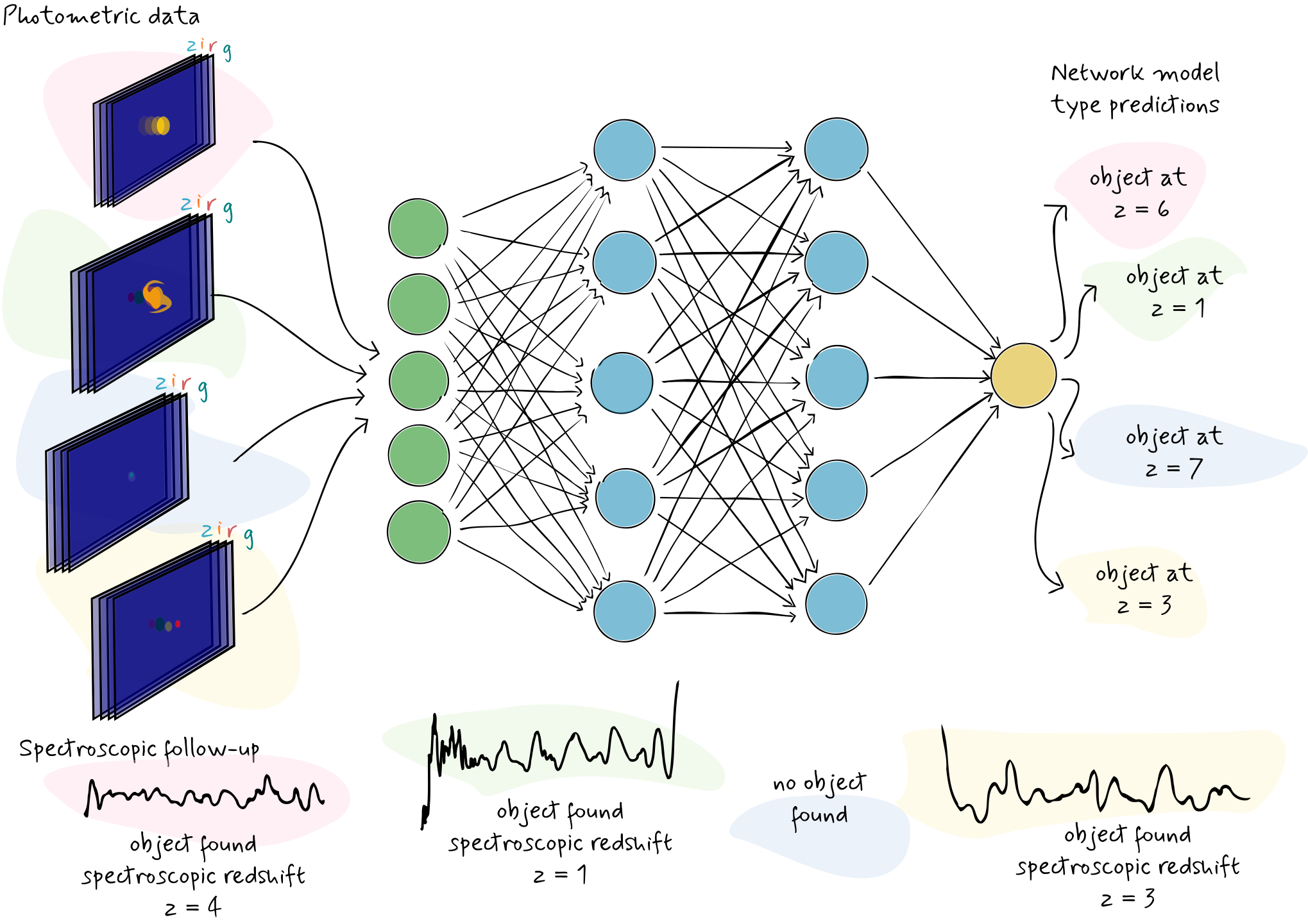
How do we choose where to target follow-up observations?
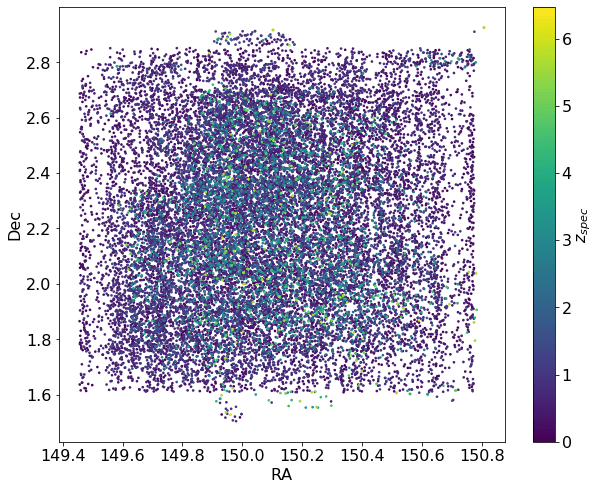
Catalogue of known objects from spectroscopy
$$i = \textrm{RA}\text{ and }\textrm{Dec}$$
RA and Dec of $\sim$ 20,000 spectroscopically observed objects, $\textsf{obj}_{\textsf{spec},i}$
$$\begin{align*} \textsf{obj}_{\textsf{spec},i}&\sim P(\textsf{obj}|\textsf{spec}_i)\\ &=\delta(i)\,\,\,\,\forall i\in\textrm{Catalogue} \end{align*}$$Error model for redshifts, $z_i$, given the spectroscopy, $\textsf{spec}_i$
$$\begin{align*} z_{\textsf{spec}, i} &\sim P(z|\textsf{spec}_i)\\ &\approx\mathcal{N}(\mu_{z_{\textsf{spec},i}}, \sigma_{z_{\textsf{spec},i}}) \end{align*}$$Joint distribution - $\displaystyle\textsf{obs}_{\textsf{spec},i}, z_{\textsf{spec}, i} \sim P(\textsf{obj}, z|\textsf{spec}_i)$
In fact we can model the joint distributions
$$z_{\textsf{phot},i}, \textsf{obj}_i \sim P_\mathscr{w}(z, \textsf{obj}|\textsf{pix}_i)$$Which comes from the conditional distribution using the chain rule
$$P_\mathscr{w}(z|\textsf{obj},\textsf{pix}_i) = P_\mathscr{w}(z|\textsf{obj}_i, \textsf{pix}_i)P_\mathscr{w}(\textsf{obj}|\textsf{pix}_i)$$Or the marginals
$$P_\mathscr{w}(z|\textsf{pix}_i) = \int_\textsf{OBJ} \hskip-0.6em d\textsf{obj}\,P_\mathscr{w}(z| \textsf{obj}, \textsf{pix}_i)P_\mathscr{w}(\textsf{obj}|\textsf{pix}_i)\,\,\,\,\text{and}\,\,\,\,P_\mathscr{w}(\textsf{obj}|\textsf{pix}_i)=\int_\textsf{REDSHIFT} \hskip-2.5em dz \,P_\mathscr{w}(\textsf{obj}|z, \textsf{pix}_i)P_\mathscr{w}(z|\textsf{pix}_i)$$Targetting rare objects
Calculate the marginal distribution for the probability of objects given particular properties, i.e.
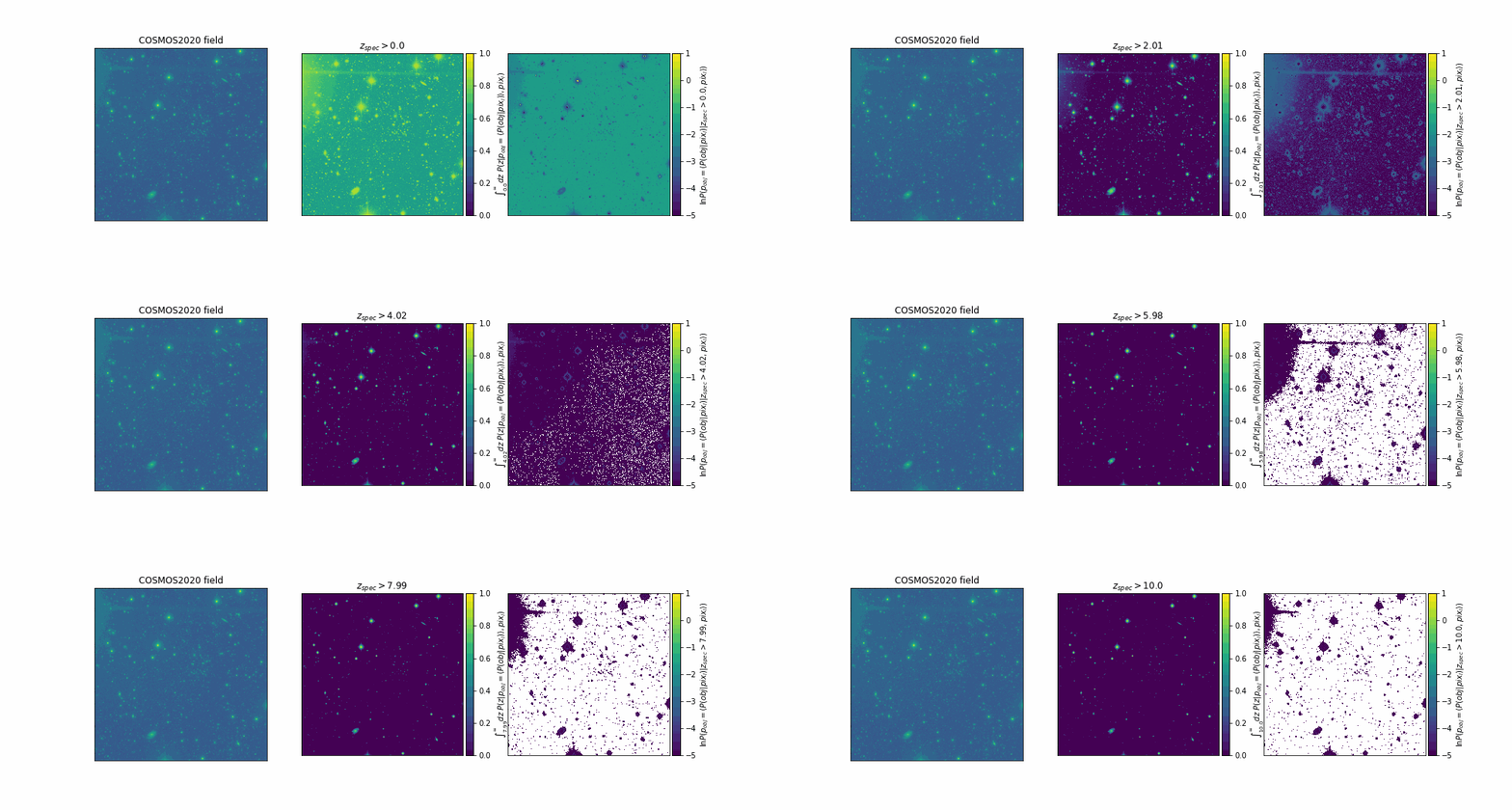
High redshift objects, i.e. $z > 6$
$$P_\mathscr{w}(\textsf{obj}|\textsf{pix}_i, z>6)=\int_6^\infty dz \,P_\mathscr{w}(\textsf{obj}|z, \textsf{pix}_i)P_\mathscr{w}(z|\textsf{pix}_i)$$Naïvely seach for maximal probability of objects
$$\hat{i} = \underset{i\in\textrm{Survey}}{\textrm{argmax}}~P_\mathscr{w}(\textsf{obj}|\textsf{pix}_i, z>6)$$This could be effectively extended to any desired attributes
The data model
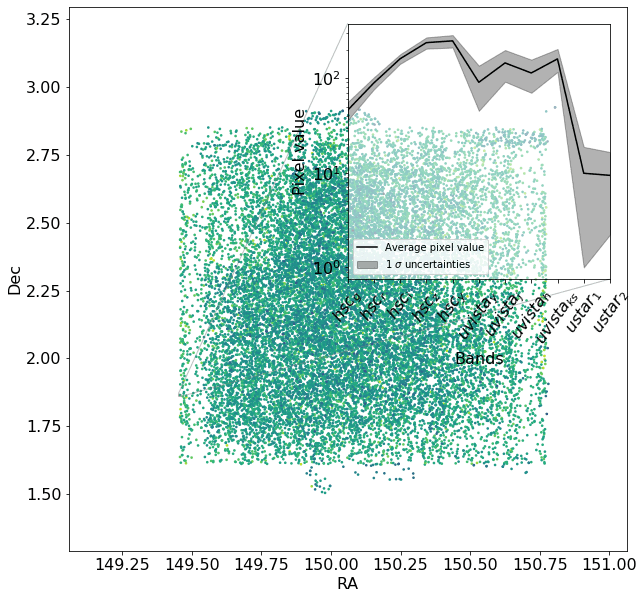
Select patches/pixels from COSMOS2020 by RA and Dec
HSC $g$, $r$, $i$, $z$, $y$
ULTRAVista $y$, $h$, $j$, $ks$
u* 1, 2
Error model for pixel values, $\textsf{pix}$:
$$\begin{align*} \textsf{pix}_i &\sim P(\textsf{pix}|\{\text{CCD read out}\}_i)\\ & \approx \mathcal{N}(\boldsymbol{\mu}_{\textsf{pix},i},\boldsymbol{\Sigma}_{\textsf{pix},i}) \end{align*}$$
Could use patches or single pixels
We've found little difference between the two forms of inputs
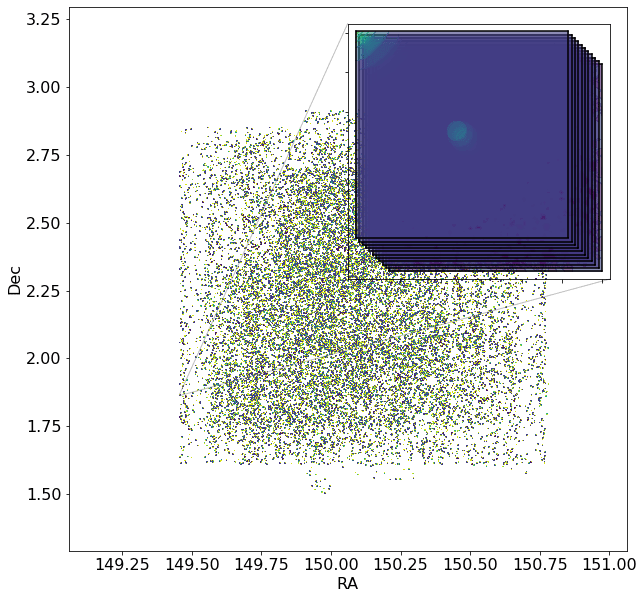
Assume a model of the objects given the input pixels at the same position as objects in the spectroscopic catalogue
$$\begin{align*} \textsf{obj}_i&\sim P(\textsf{obj}|\textsf{pix}_i)\\ &=\delta(i)\,\,\,\,\forall i\in\textrm{Catalogue} \end{align*}$$Build model of suspected background
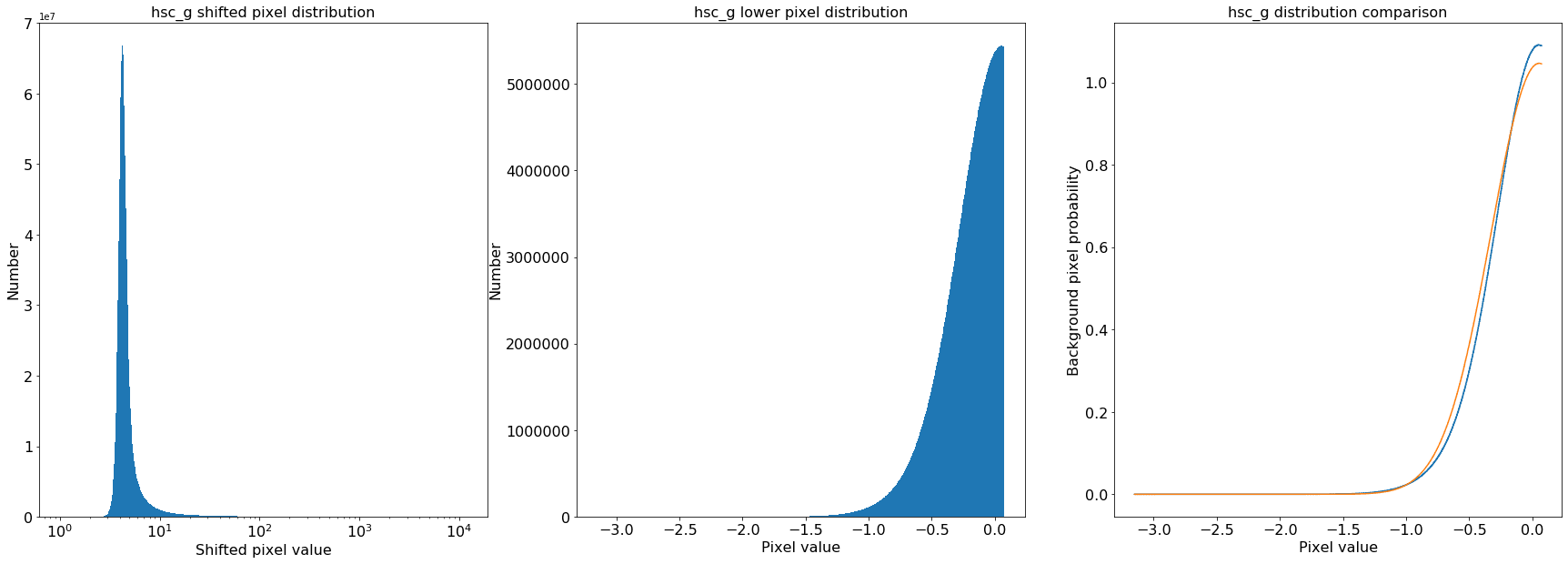
$$\begin{align*}
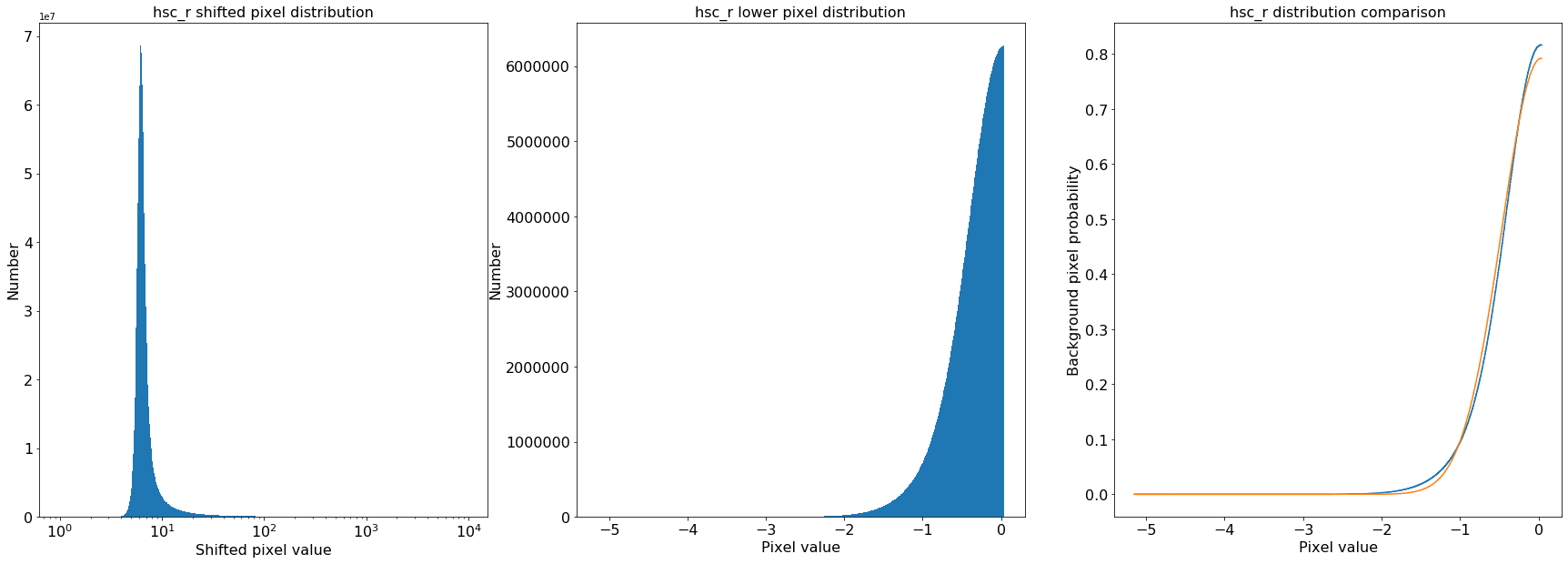
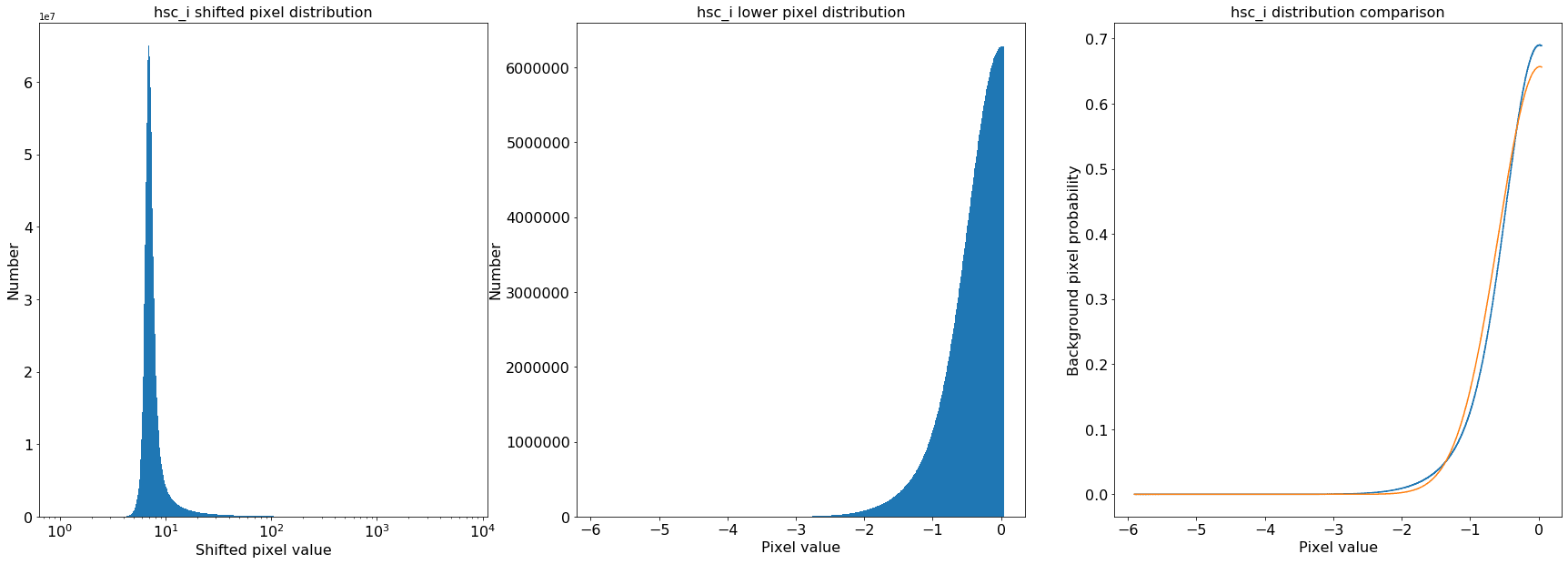
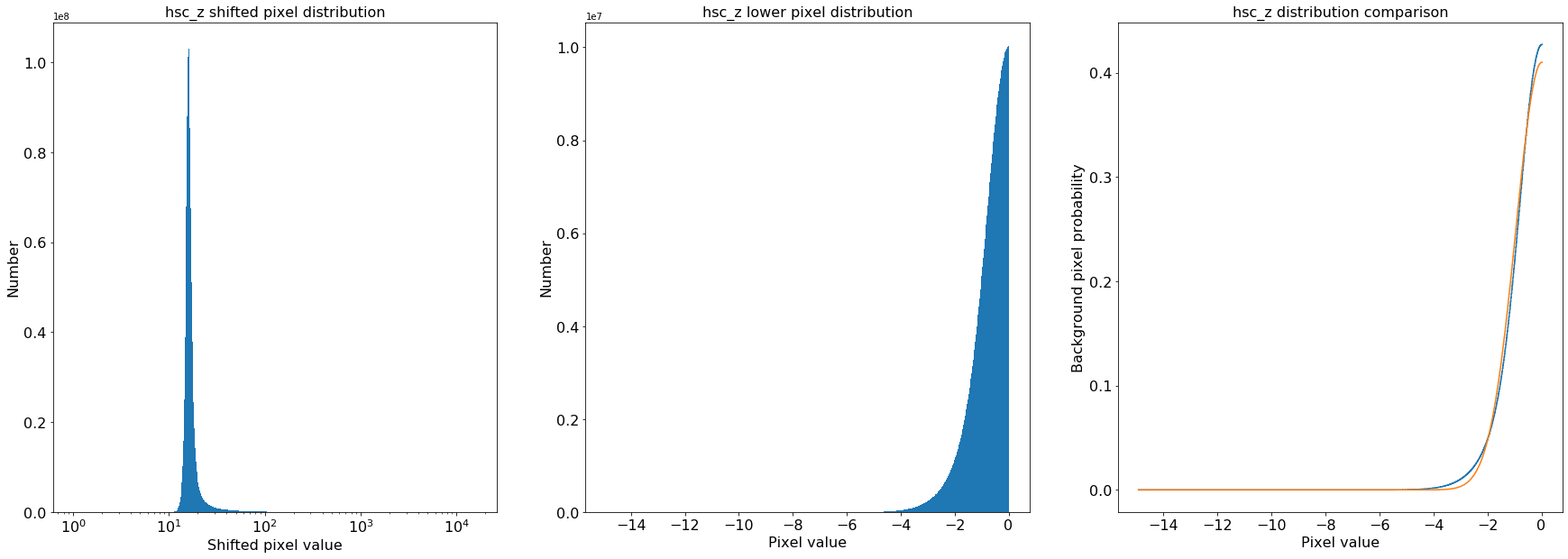
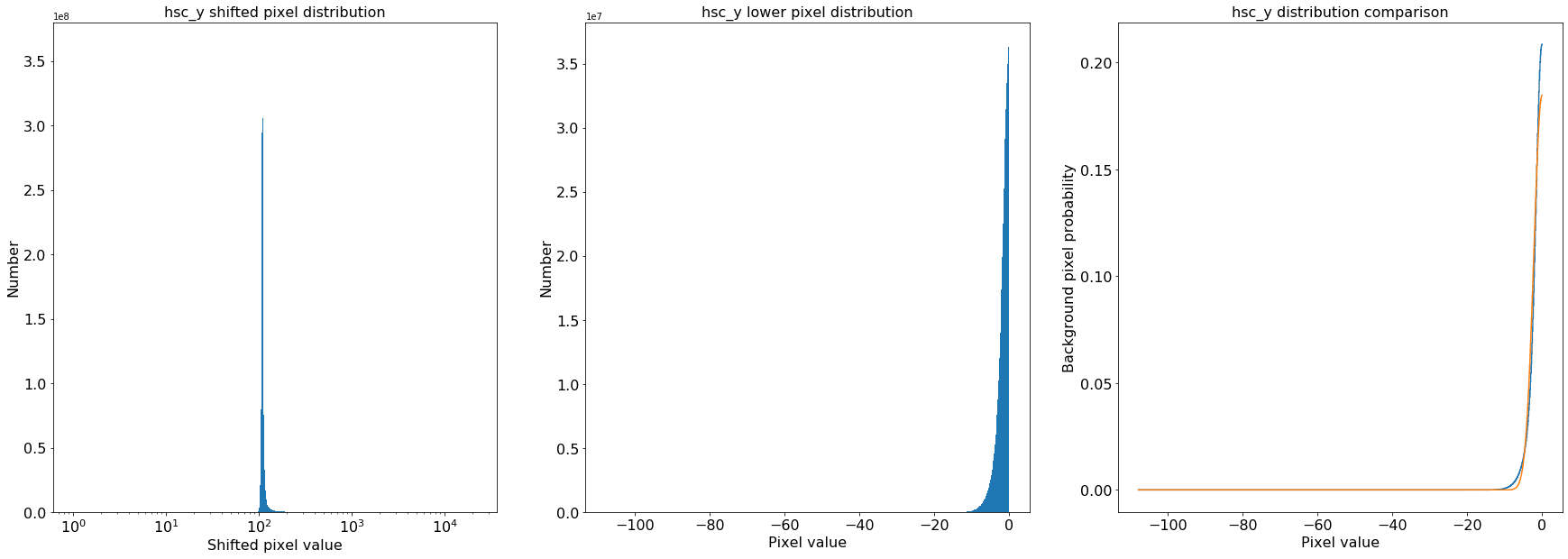
\textsf{pix}_{\textsf{background},i}&\sim \mathcal{N}(\boldsymbol{\mu}_{\textsf{background}}, \boldsymbol{\Sigma}_{\textsf{background}})\\
\textsf{obj}_{\textsf{background},i}&\sim P(\textsf{obj}|\textsf{pix}_{\textsf{background},i})\\
&=0
\end{align*}$$
$$\begin{align*}
z_{\textsf{background},i}&\sim \textrm{Uniform}(0, \infty)\\
z_i&\sim P(z|\textsf{obj}_{\textsf{background},i}=0, \textsf{pix}_{\textsf{background},i})\\
&=1/\infty
\end{align*}$$
The model
Model as a simple single parameter distribution, such as Bernoulli
$$P_\mathscr{w}(\textsf{obj}|\textsf{pix}_i) = \textrm{Bernoulli}(p(\textsf{pix}_i, \mathscr{w}))$$Modelling the probability of redshifts given the existance of objects
Flexible enough to model the fact that the distribution of objects is skewed
Simple enough that we can perform analytical integrals
Mixture of Gaussians
$$P_\mathscr{w}(z|\textsf{obj}_i, \textsf{pix}_i) = \sum_k \alpha_k(\textsf{pix}_i, \mathscr{w})\hskip0.1em\mathcal{N}\hskip-0.25em\left(\mu_k(\textsf{pix}_i, \mathscr{w}), \sigma_k(\textsf{pix}_i, \mathscr{w})\right)$$Distribution of spectroscopic redshifts in a spectroscopic catalogue
According to data, there should always be more likely to have objects with redshifts between 0 and 1
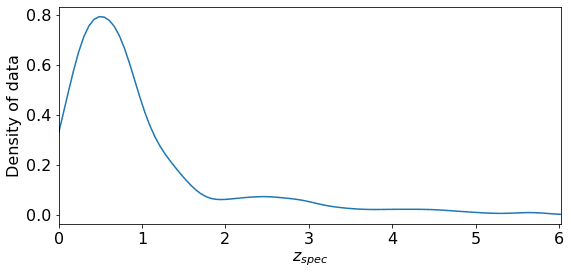
The first fits the data better, but we can't see it because the mean and mode are not good measures...
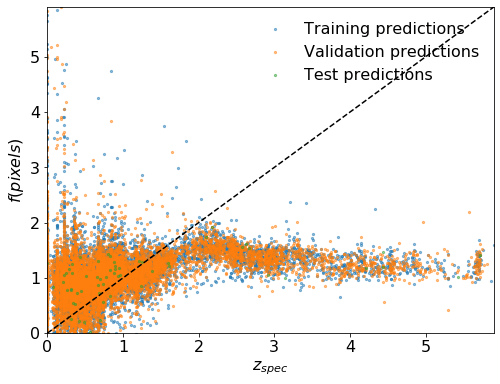
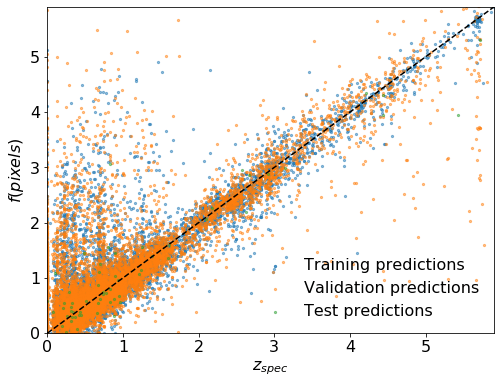
If we want a flat prior over physical properties, we need to reweight the effect of the data
The mean of the data distribution
(for a single Gaussian)
The mean of the (approximate) physical distribution
(for a single Gaussian)
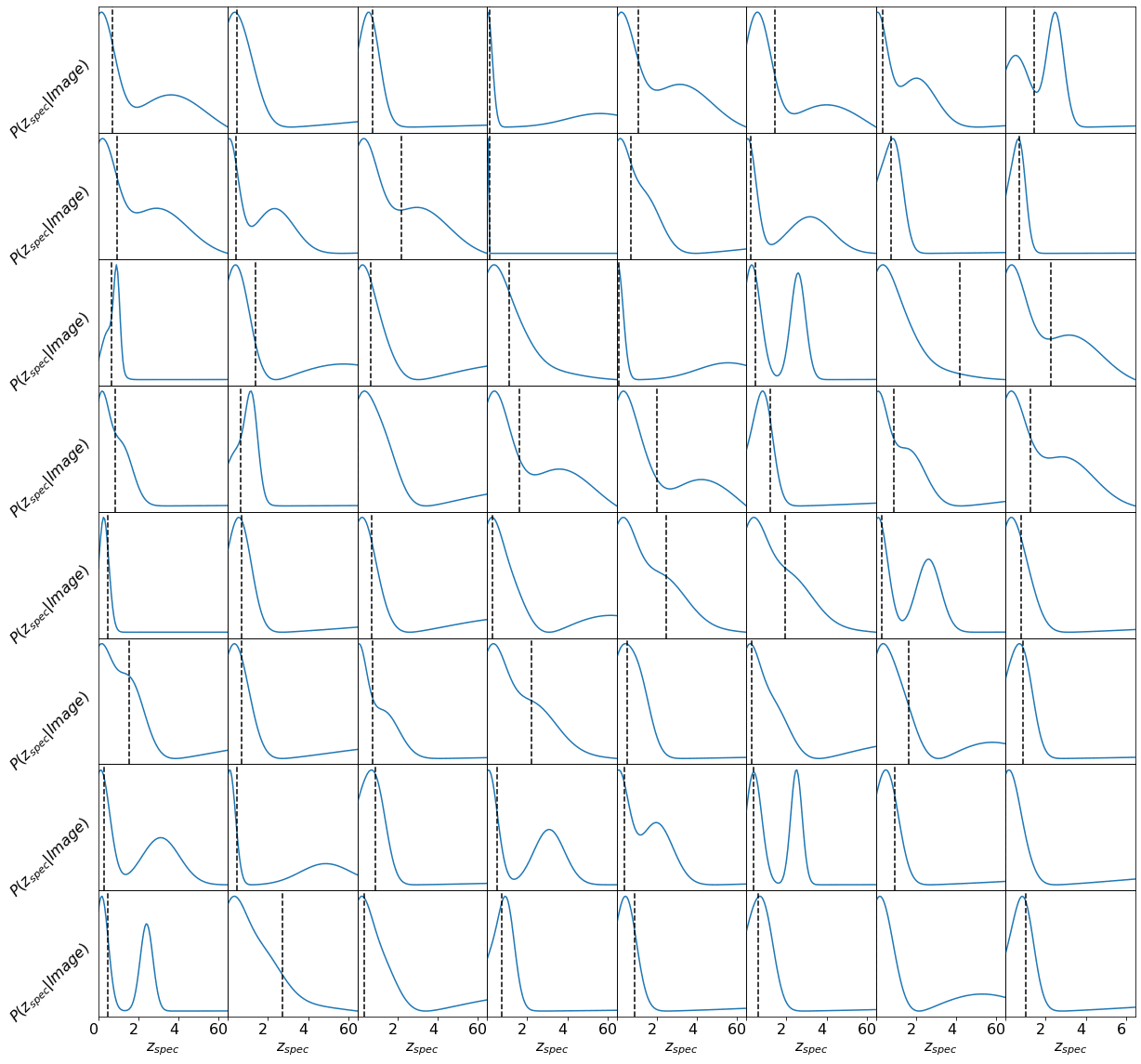
Minimise the KL divergence between the joint distribution of the existance of objects and their redshifts from spectroscopy
$$\begin{align*}
\textrm{KL}(P||P_\mathscr{w}) & = \left\langle\ln\frac{P}{P_\mathscr{w}}\right\rangle\\
&=\sum_{i\in\textrm{Catalogue}} \hskip-0.5em\lambda_i\big[\ln P(z=z_{\textsf{spec},i}|\textsf{spec}_i) - \ln P_\mathscr{w}(\textsf{obj}=1, z=z_{\textsf{spec},i}|\textsf{pix}_i)\big]\\
&\phantom{=}+\sum_{i\in\textrm{dim}[\textrm{Catalogue}]} \hskip-1.2em\big[\ln P(z=z_{\textsf{background},i})- \ln P_\mathscr{w}(\textsf{obj}=0, z=z_{\textsf{background},i}|\textsf{pix}_{\textsf{background},i})\big]
\end{align*}$$
Training
- Sample
- $\{z_{\textsf{spec}, i\color{gray}{, j}}\sim\mathcal{N}(\mu_{z_{\textsf{spec}, i}}, \sigma_{z_{\textsf{spec}, i}})~|~i\in\textrm{Catalogue}\color{gray}{,~j\in[1, \textrm{MC samples}]}\}$
- $\{\textsf{pix}_{i}\sim\mathcal{N}(\boldsymbol{\mu}_{\textsf{pix},i}, \boldsymbol{\Sigma}_{\textsf{pix}, i})~|~i\in\textrm{Catalogue}\}$
- $\{z_{\textsf{background}, i\color{gray}{, j}}\sim\textrm{Uniform}(0,\infty)~|~i\in\textrm{dim}[\textrm{Catalogue}]\color{gray}{,~j\in[1,\textrm{MC samples}]}\}$
- $\{\textsf{pix}_{\textsf{background}, i}\sim\mathcal{N}(\boldsymbol{\mu}_{\textsf{background}}, \boldsymbol{\Sigma}_{\textsf{background}})~|~i\in\textrm{dim}[\textrm{Catalogue}]\}$
Calculate
- $\{\lambda_i\ln\mathcal{N}(z=z_{\textsf{spec}, i\color{gray}{, j}}|\mu_{z_{\textsf{spec},i}}, \sigma_{z_{\textsf{spec},i}})~|~i\in\textrm{Catalogue}\color{gray}{,~j\in[1,\textrm{MC samples}]}\}$
- $\{\lambda_i\ln P_\mathscr{w}(\textsf{obj}=1,z=z_{\textsf{spec}, i\color{gray}{, j}}|\textsf{pix}_i)~|~i\in\textrm{Catalogue}\color{gray}{~,j\in[1,\textrm{MC samples}]}\}$
- $\{\ln\textrm{Uniform}(z=z_{\textsf{background}, i\color{gray}{, j}}|0,\infty)~|~i\in\textrm{dim}[\textrm{Catalogue}]\color{gray}{,~j\in[1,\textrm{MC samples}]}\}$
- $\{\ln P_\mathscr{w}(\textsf{obj}=0,z=z_{\textsf{background}, i\color{gray}{, j}}|\textsf{pix}_{\textsf{background},i})~|~i\in\textrm{dim}[\textrm{Catalogue}]\color{gray}{,~j\in[1,\textrm{MC samples}]}\}$
$$\textrm{KL}=\sum_{i\color{gray}{, j}}(A - B) + \sum_{i\color{gray}{, j}}(C - D)$$
- Minimise the KL divergence $$\widehat{\mathscr{w}} = \underset{\mathscr{w}\in\mathscr{W}}{\textrm{argmin}}~\textrm{KL}$$
Targetting objects by maximising the probability of particular properties over entire field
$$\hat{i} = \underset{i\in\textrm{Survey}}{\textrm{argmax}}~P_\mathscr{w}(\textsf{obj}, z|\textsf{pix}_i)$$