Parameter inference using neural networks
Tom Charnock
Institut d'Astrophysique de Paris
Notebook: presentations.charnock.fr/PI_NN/Pisa



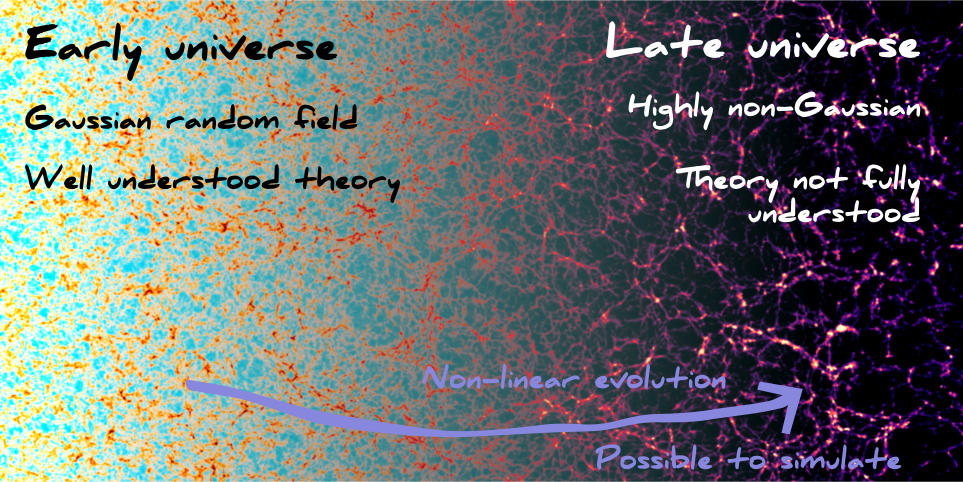
Cosmology from the universe
We used to write an analytic likelihood
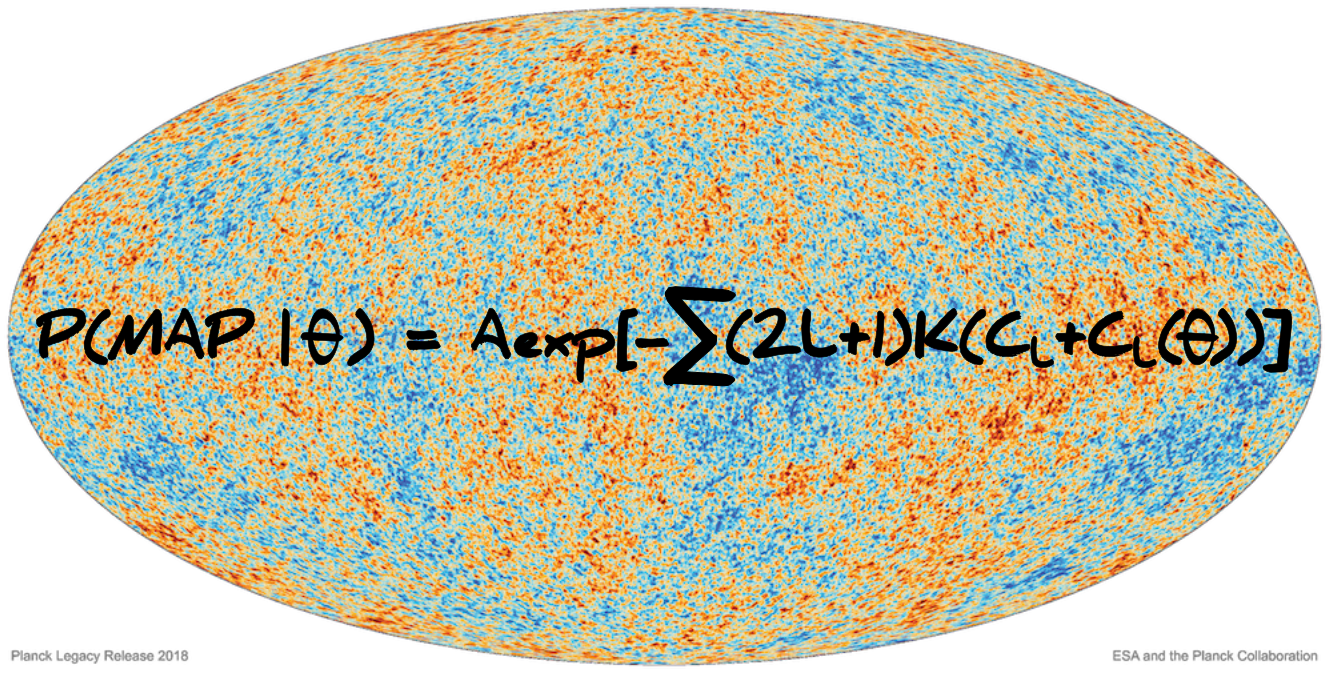
and perform MCMC
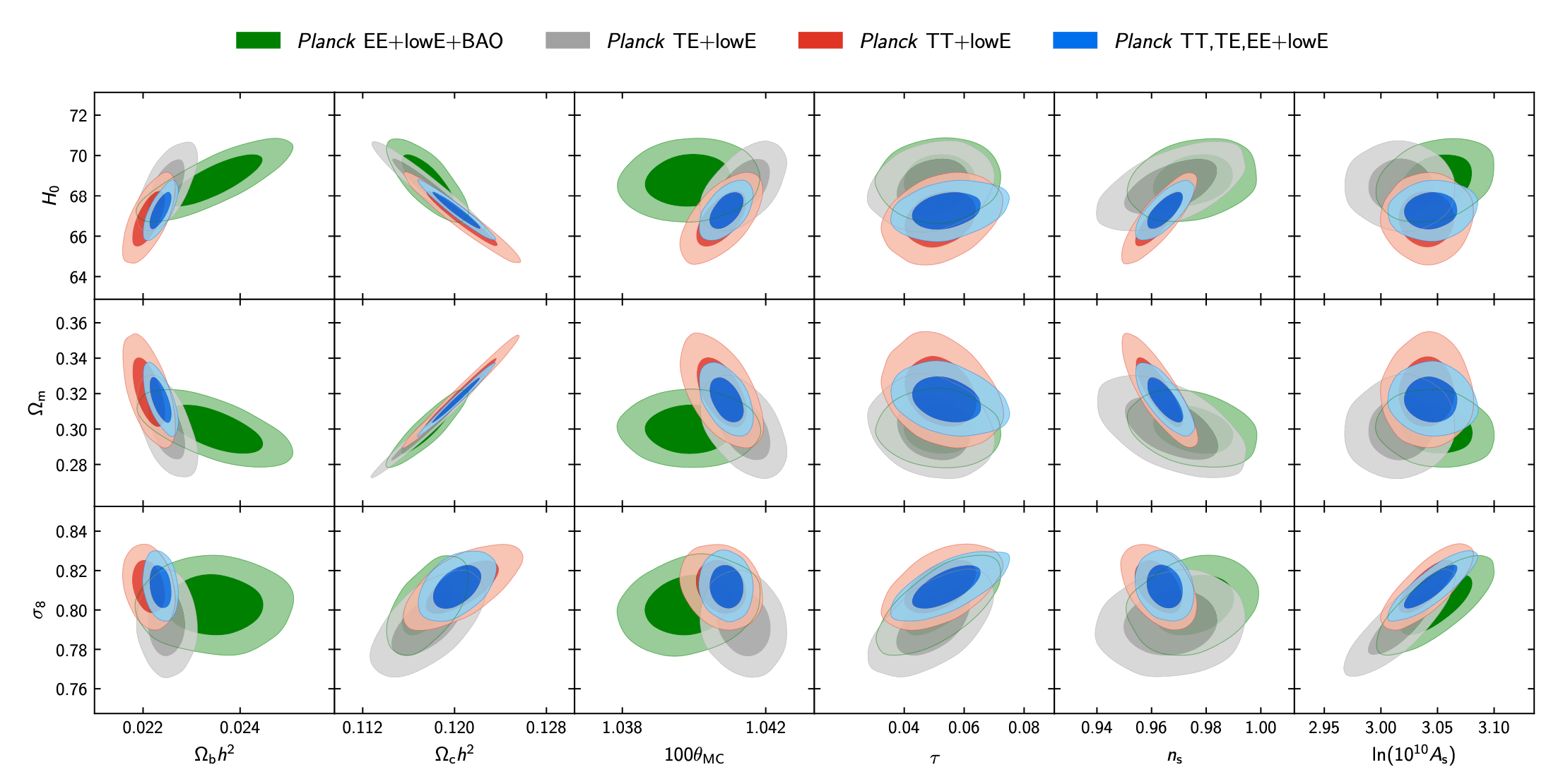
Likelihoods now not available

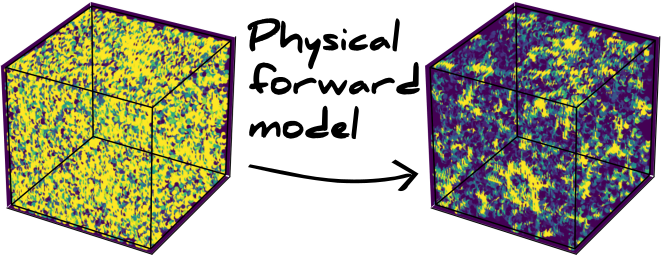
Or use forward-modelling and likelihood-free inference
Enter the neural network
What is a neural network?
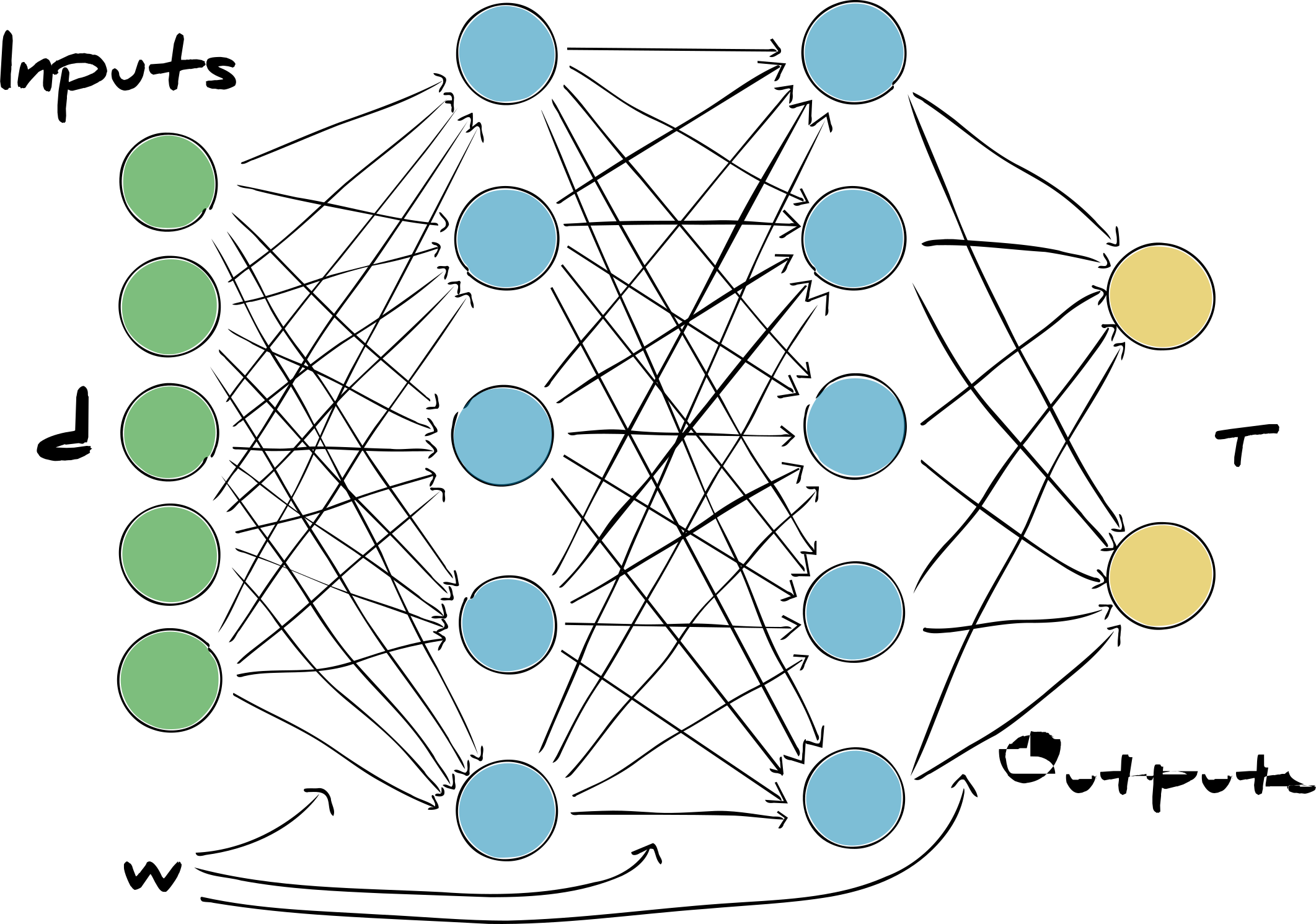
An arbitrary, non-linear function $(\mathscr{f}:\mathbb{R}^{\bf d}\rightarrow\mathbb{R}^\boldsymbol{t})$ with fittable parameters $(\boldsymbol{w})$
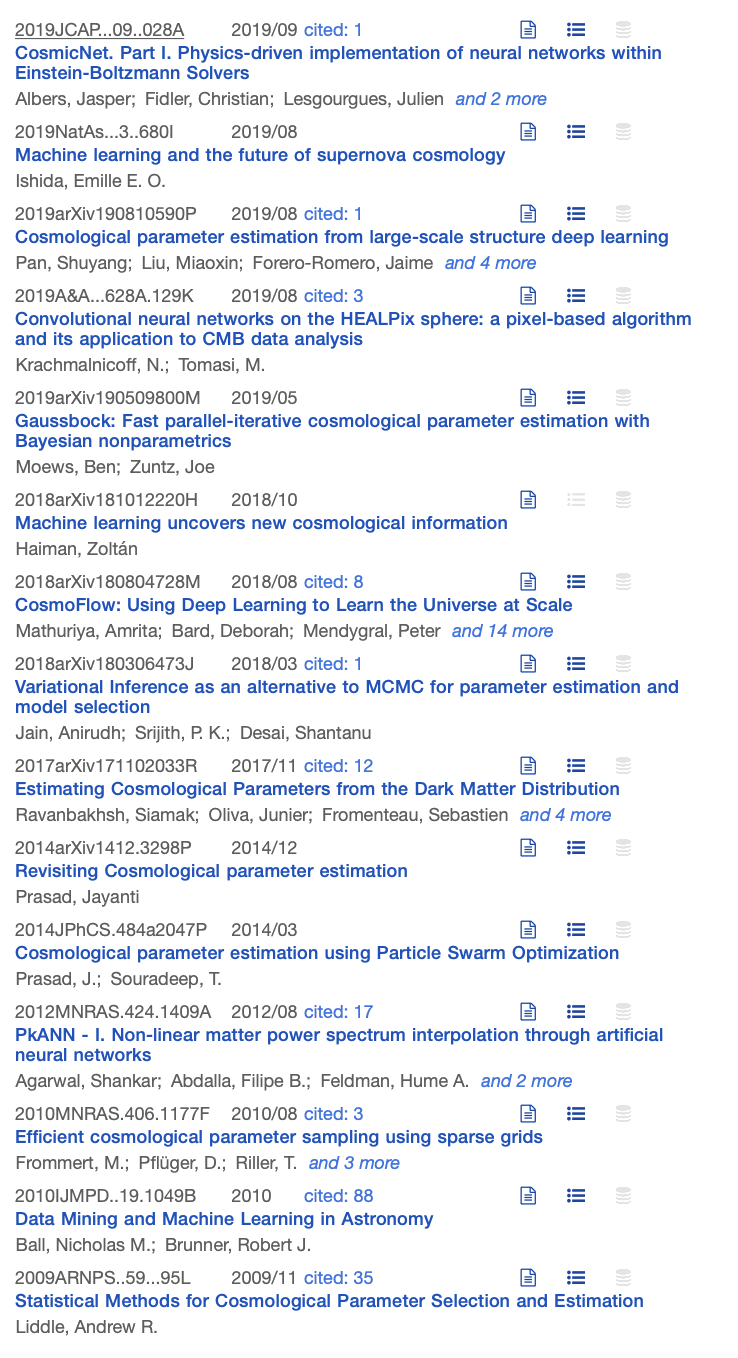
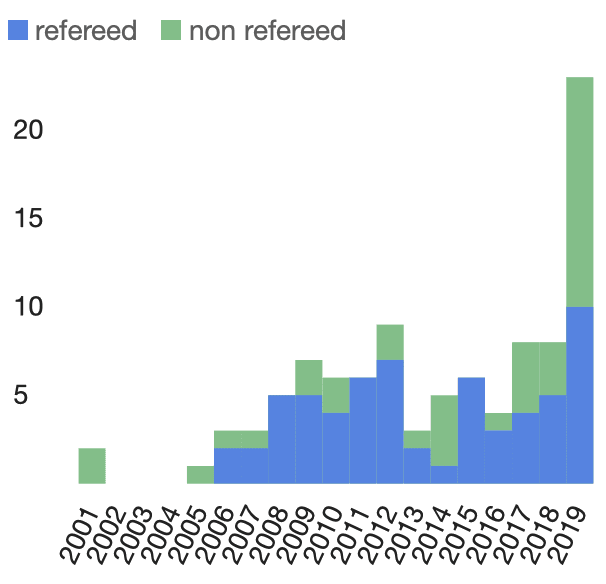
Only provide intrinsically biased estimates!
To see why we need to do some stats
A physical model
The generator $({\bf d}\in\mathcal{M}(\boldsymbol{\theta}))$ of physical data $({\bf d})$ with model parameters $(\boldsymbol{\theta})$
The likelihood and the posterior
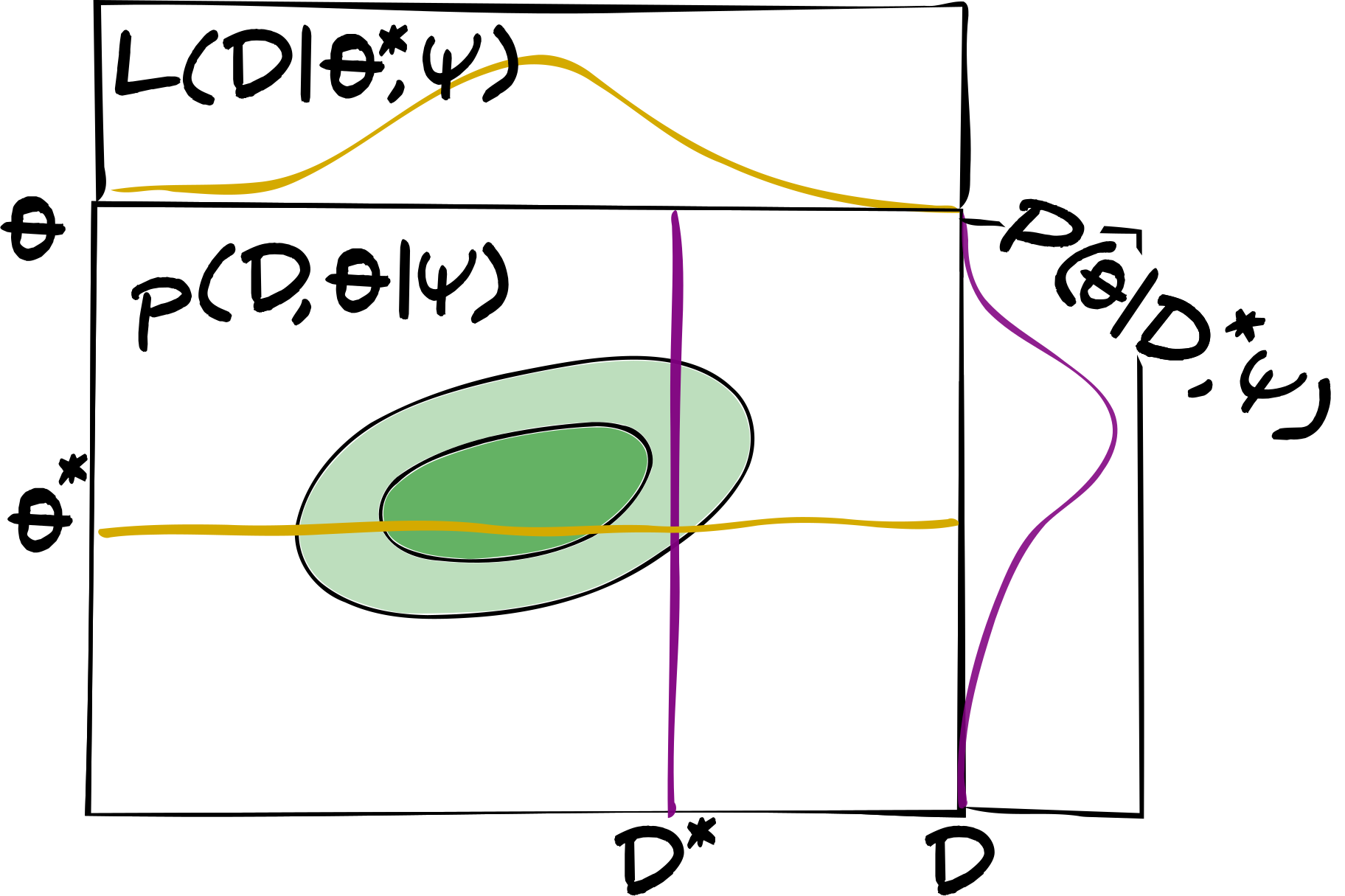
What is the probability that the model generates data ${\bf d}$ given a set of model parameters $\boldsymbol{\theta}^*$?
Posterior $\mathcal{P}(\boldsymbol{\theta}|{\bf d}^*)$
What is the probability that model parameters $\boldsymbol{\theta}$ generate the data ${\bf d}^*$?
Fisher information
$${\bf F}_{\alpha\beta} = \left.\left\langle\frac{\partial^2\ln\mathcal{L}({\bf d}|\boldsymbol{\theta})}{\partial\theta_\alpha\partial\theta_\beta}\right\rangle\right|_{\boldsymbol{\theta}=\boldsymbol{\theta}^*}$$
For a Gaussian
$${\bf F}_{\alpha\beta} = \frac{\partial\mu}{\partial\theta_\alpha}^T{\bf C}^{-1}\frac{\partial\mu}{\partial\theta_\beta}.$$

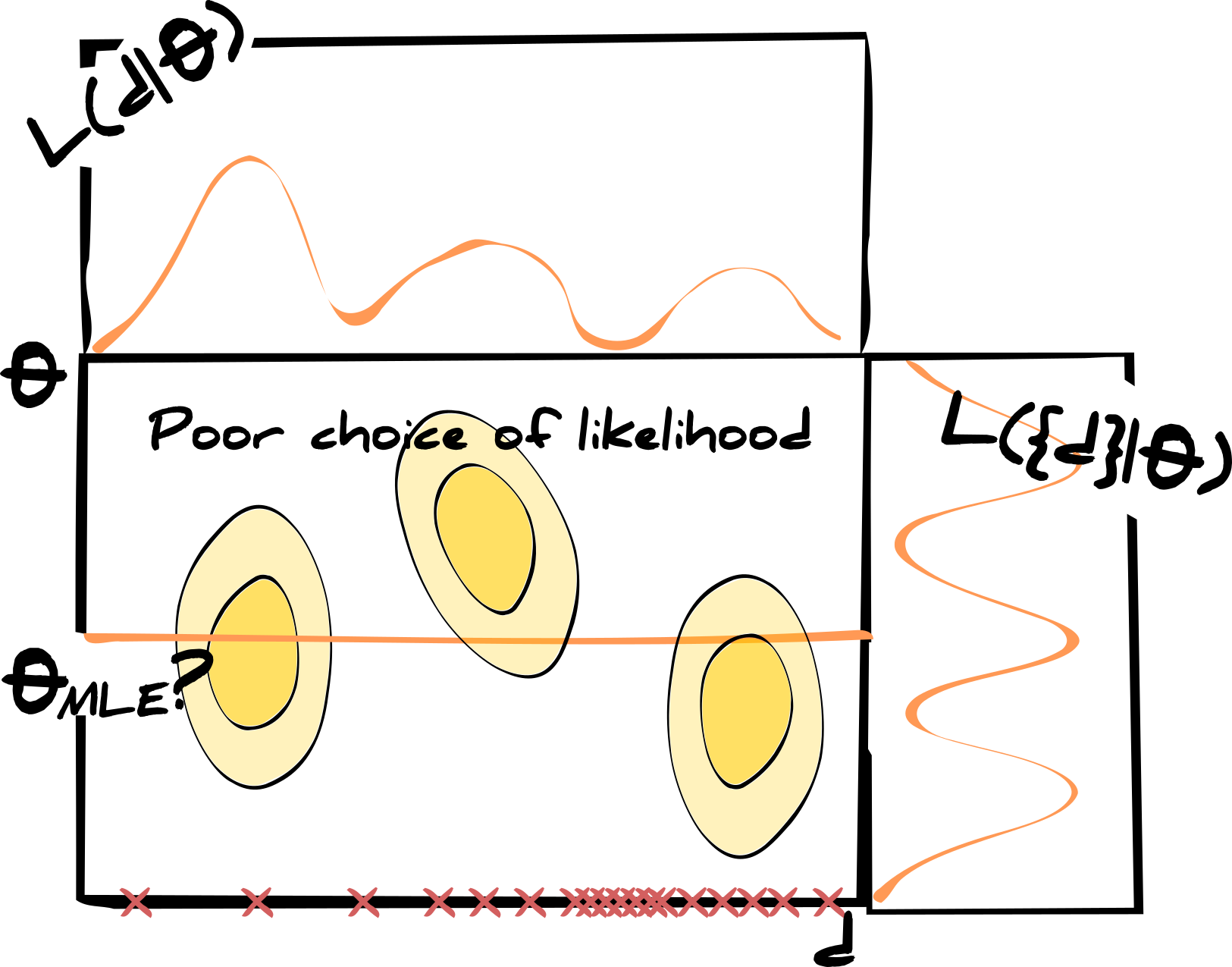
Maximum likelihood estimates
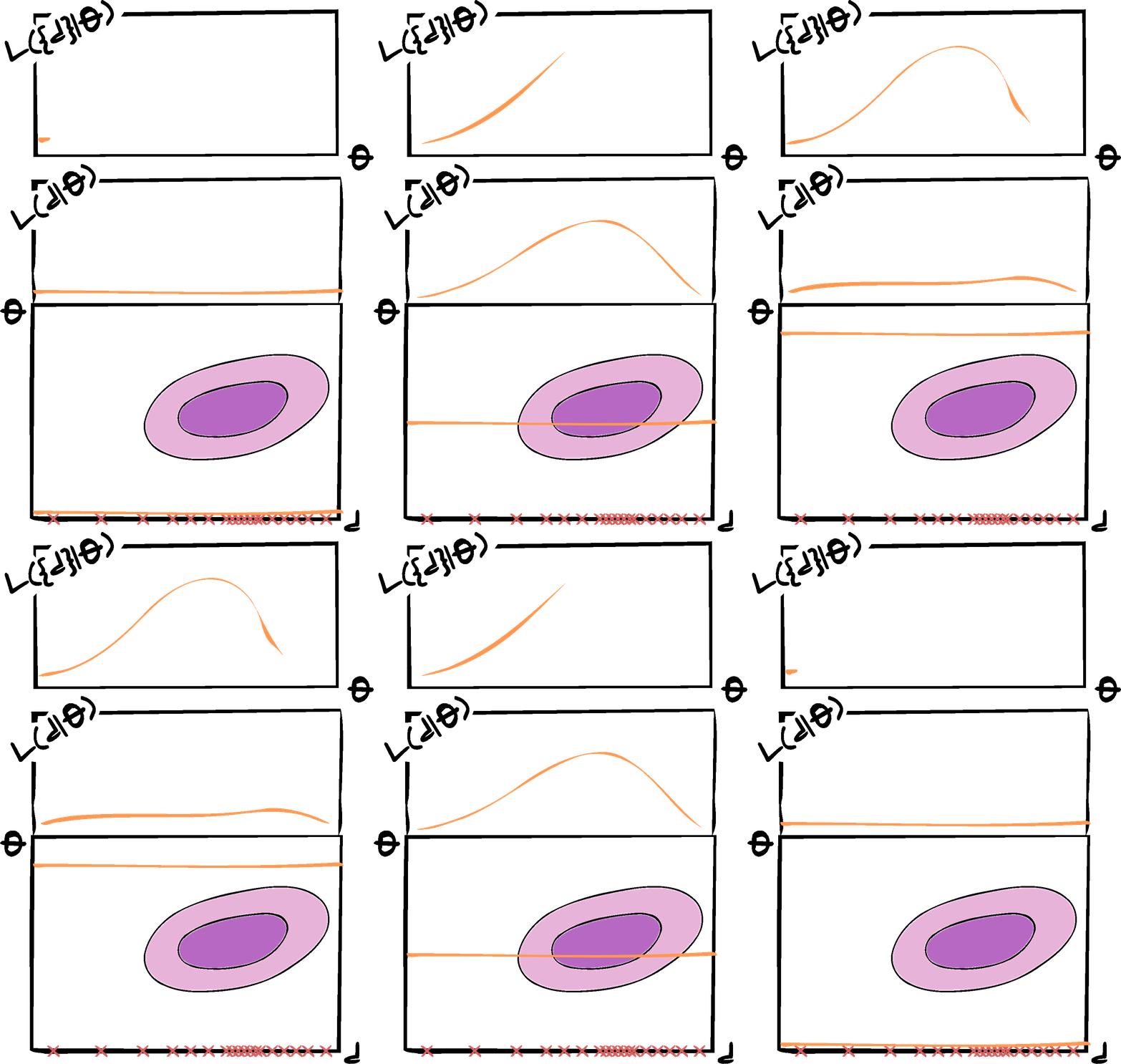
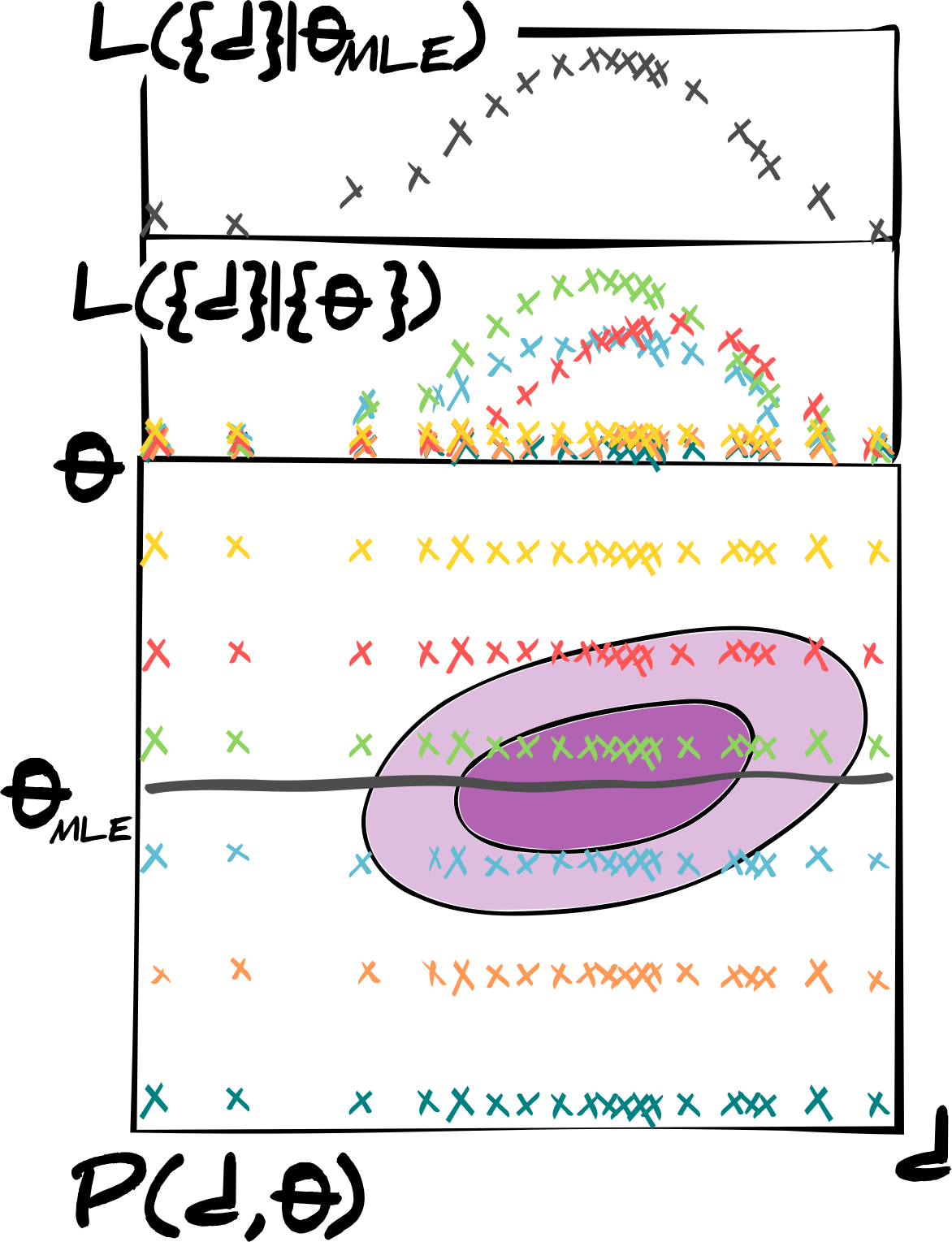 $$\mathcal{L}(\{{\bf d}\}|\boldsymbol{\theta}_\textsf{MLE})=\underset{\boldsymbol{\theta}\in\boldsymbol{\Theta}}{\textsf{Sup}}~\mathcal{L}(\{{\bf d}\}|\boldsymbol{\theta})$$
Intrinsically biased estimators
Intrinsically biased estimators
A summary of the parameters which is conditioned on the wrong likelihood.
Training a network
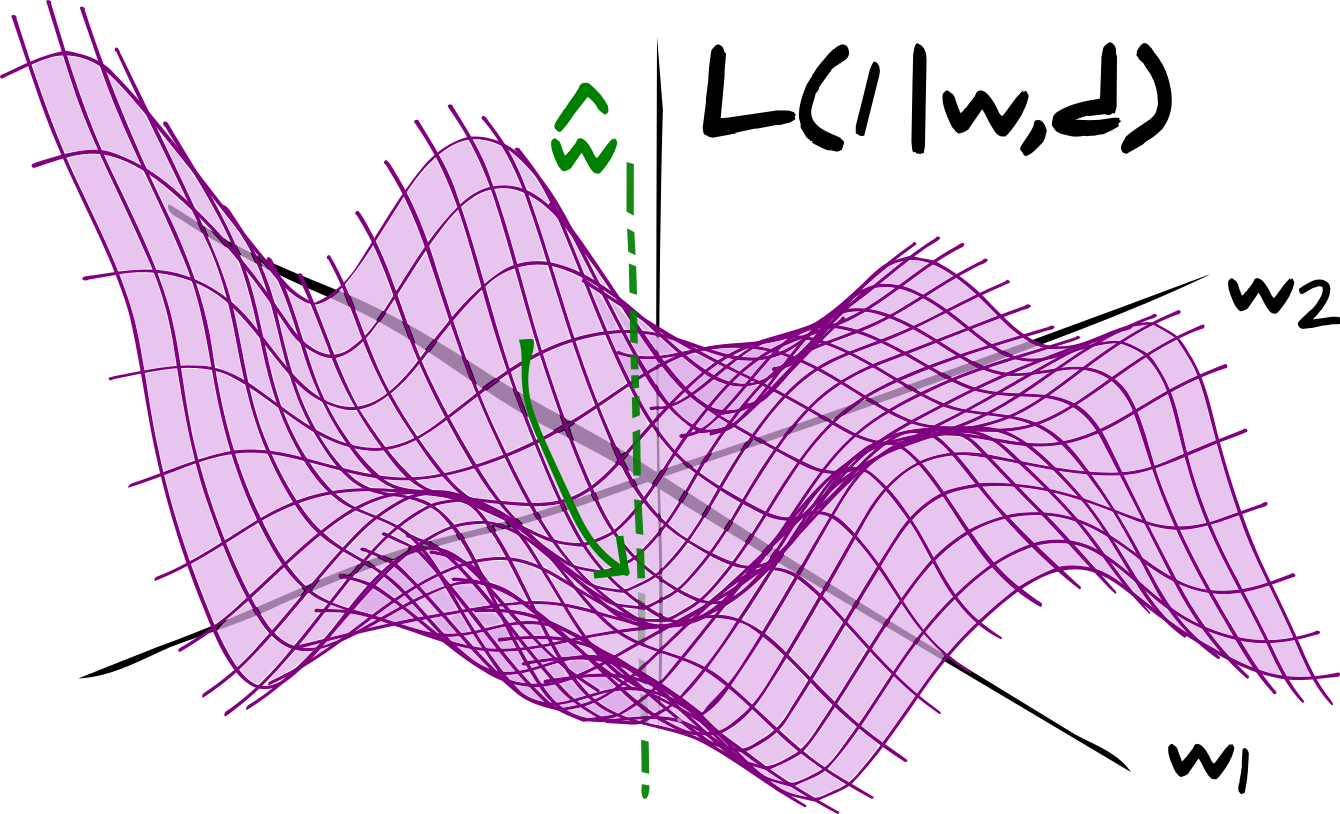
Training amounts to finding the maximum likelihood estimates of the weights for a chosen cost function $\boldsymbol{l}$.
Why do neural networks give intrinsically biased estimates?
The likelihood surface is not knowably convex (or concave)
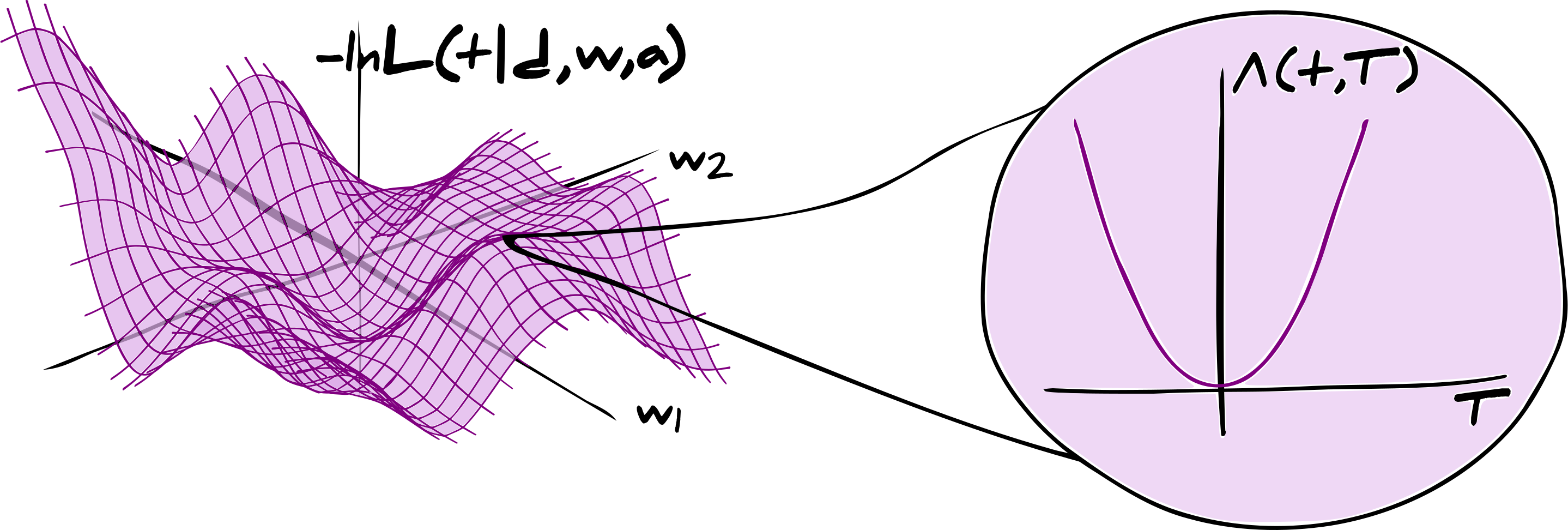
The likelihood surface is conditional on the architecture and the data
There is no known correct minimum which is complete for all data
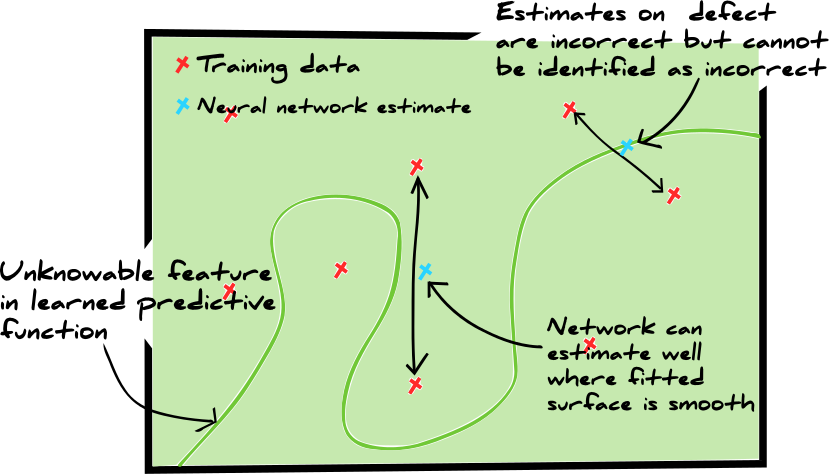
Even well converged networks are unknowably biased
In general outputs are highly informative
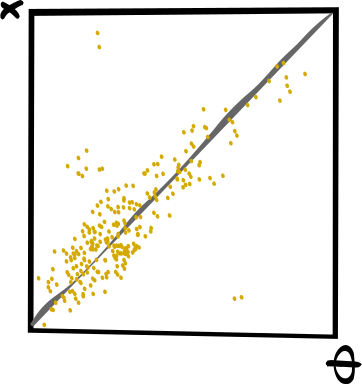
They cannot be trusted as true predictions of the parameters
The can be used as informative summaries!
How can we use a neural network then?
Build it into the physical model
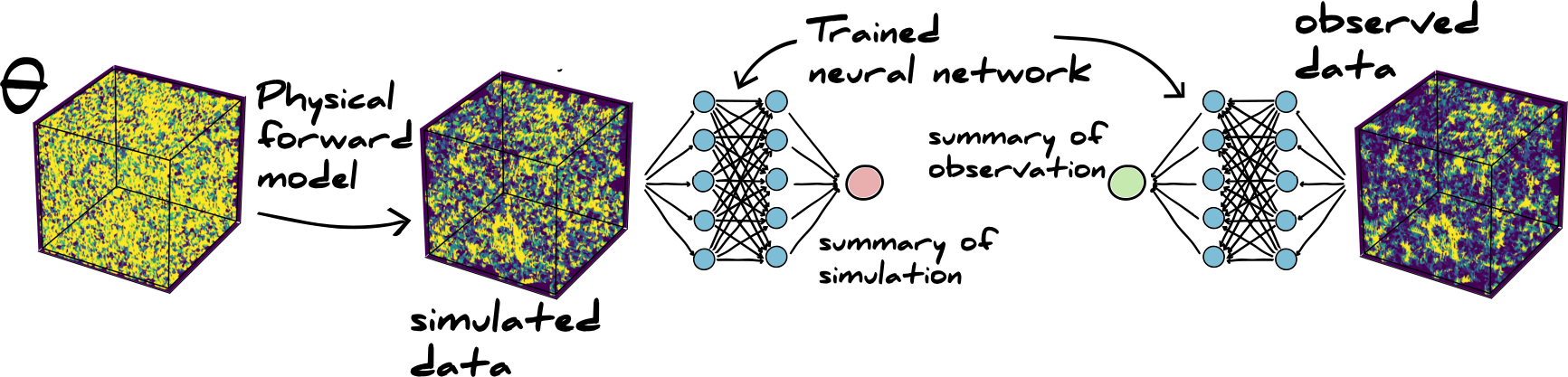
Likelihood-free inference using machine learning
Approximate Bayesian computation
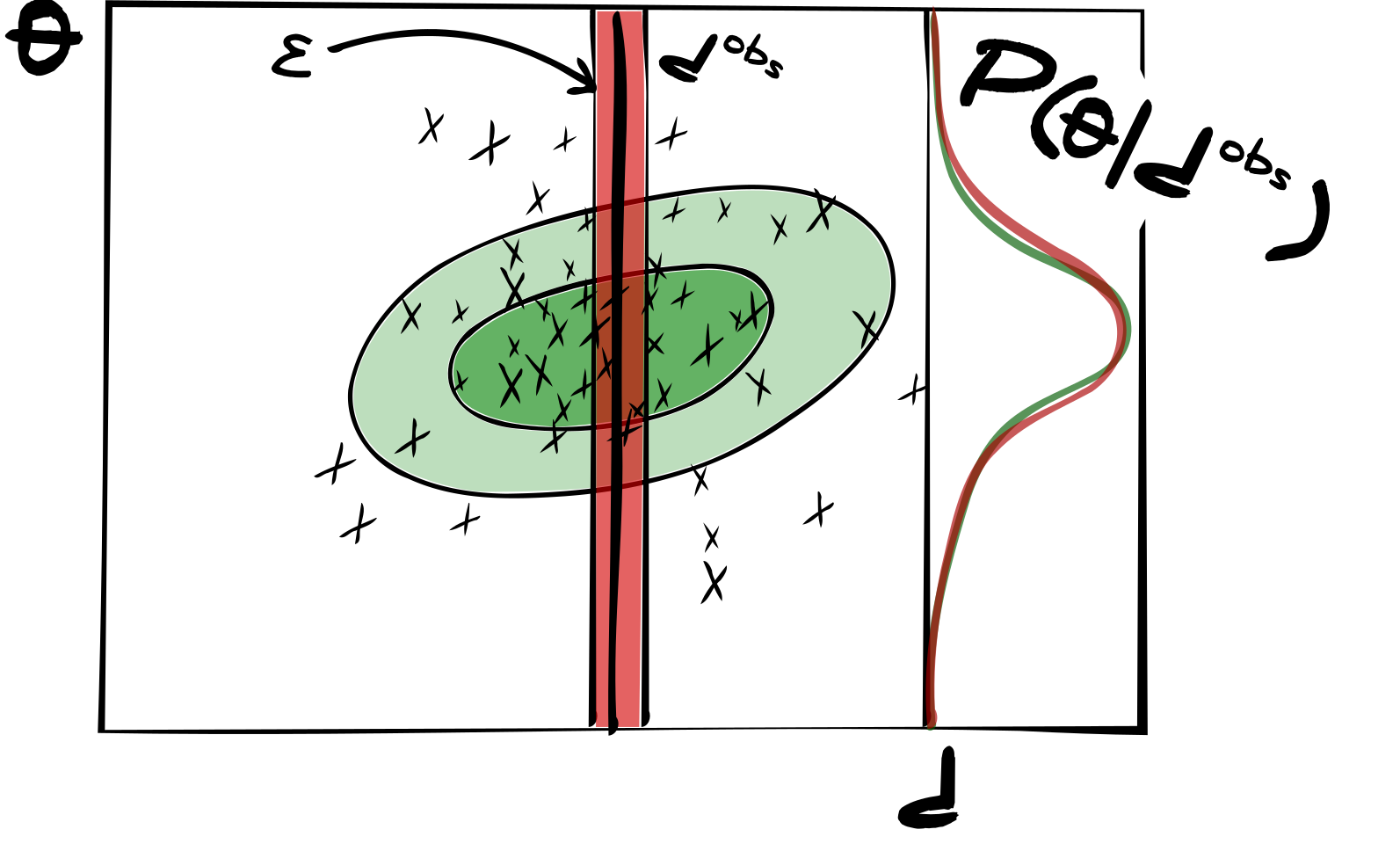
Why even introduce the neural network?
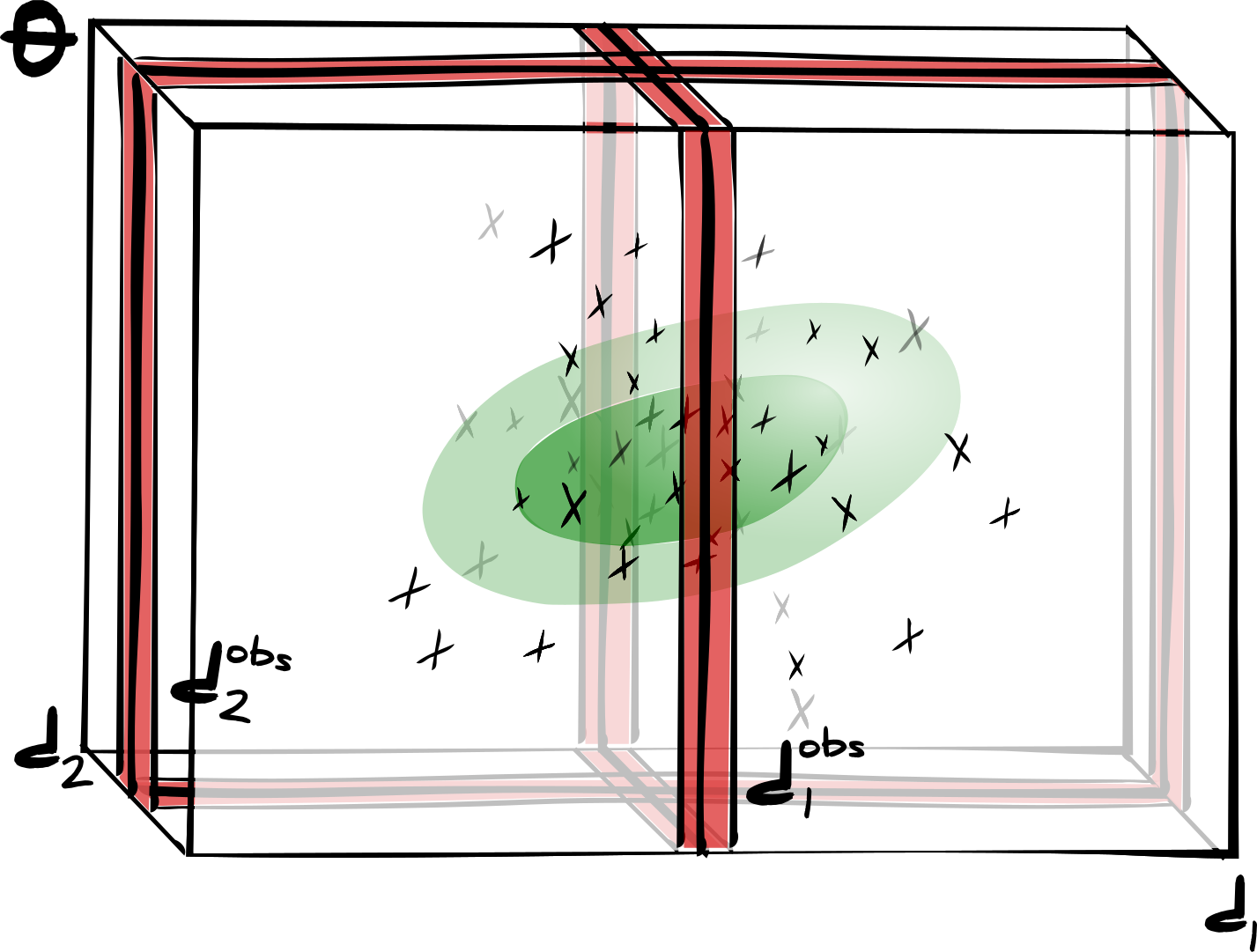
Inadequate sampling
Impossibly large numbers of simulations become necessary to correctly sample the posterior
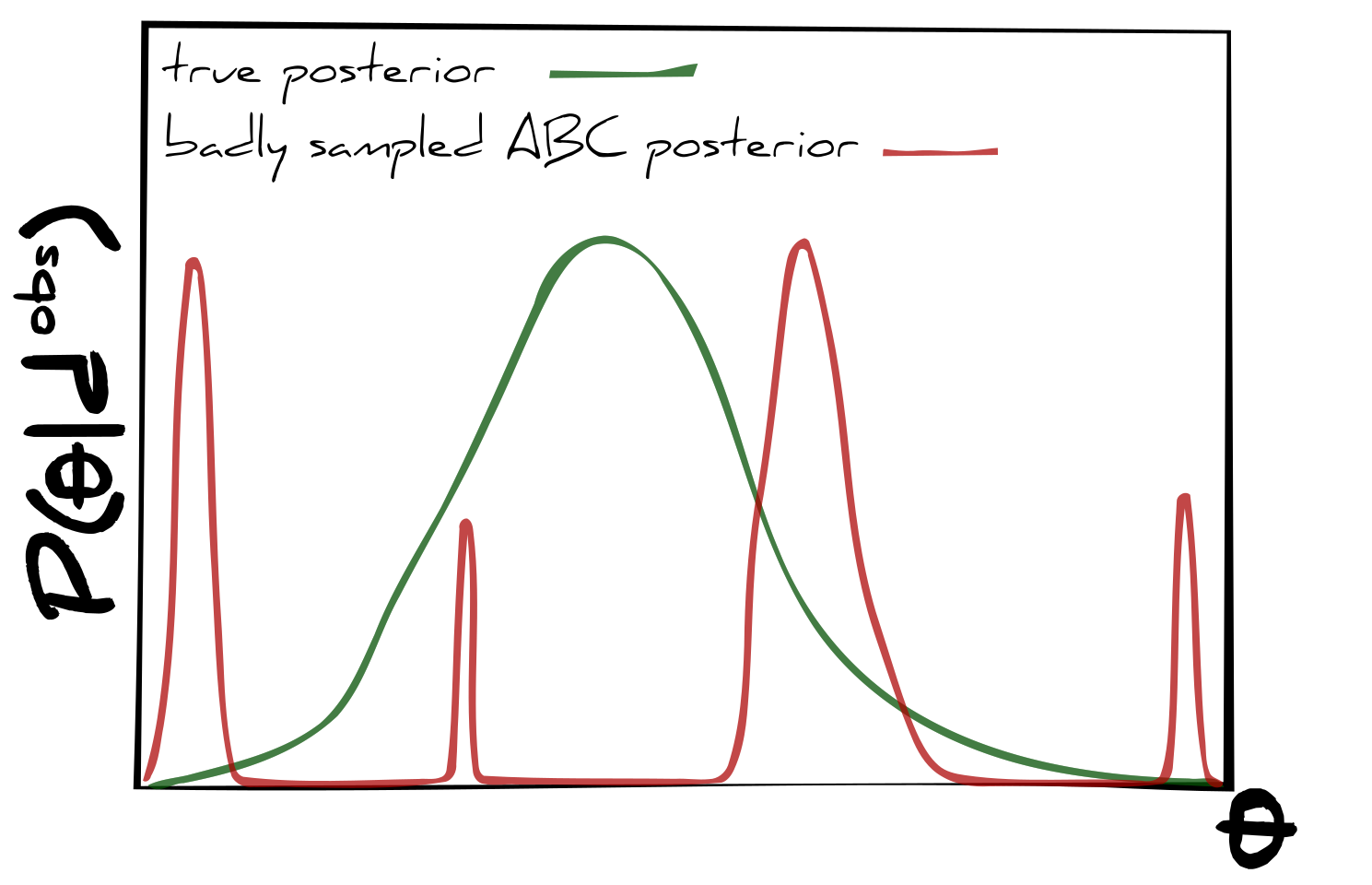
We need to do some compression
Any pretrained neural network could be used
Is there a well motivated choice?
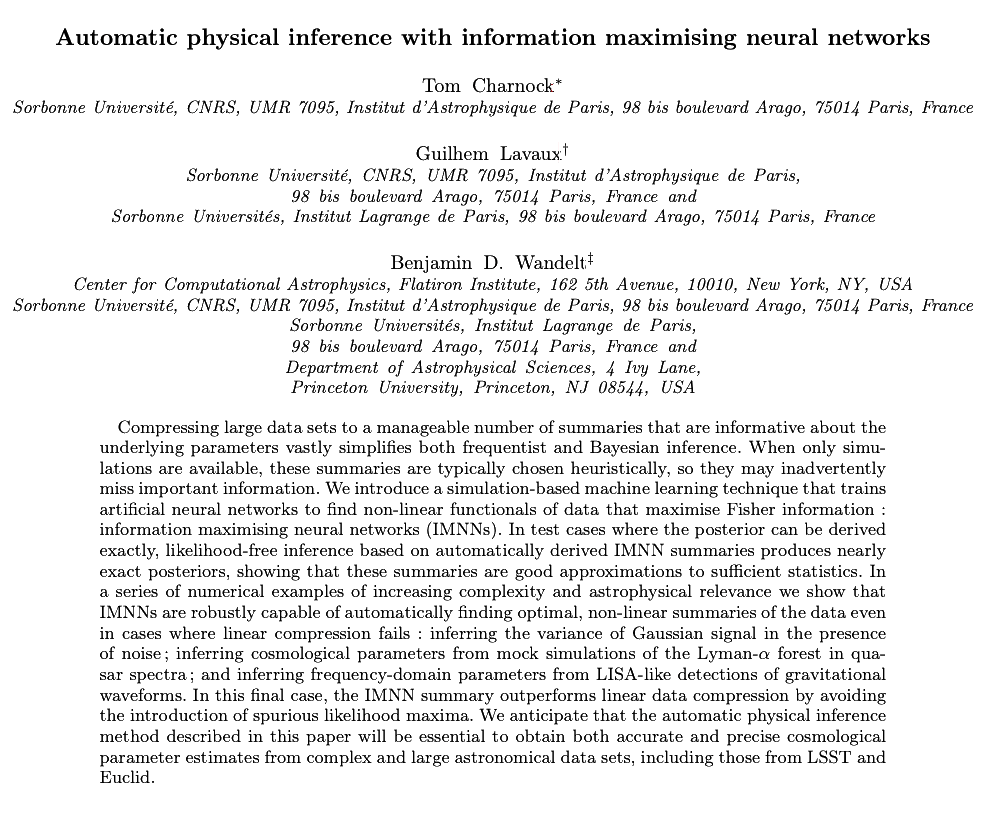
Information maximising neural networks
$$\mathcal{L}({\bf d}|\boldsymbol{\theta})\to\mathcal{L}({\bf x}|\boldsymbol{\theta}, {\bf d})$$
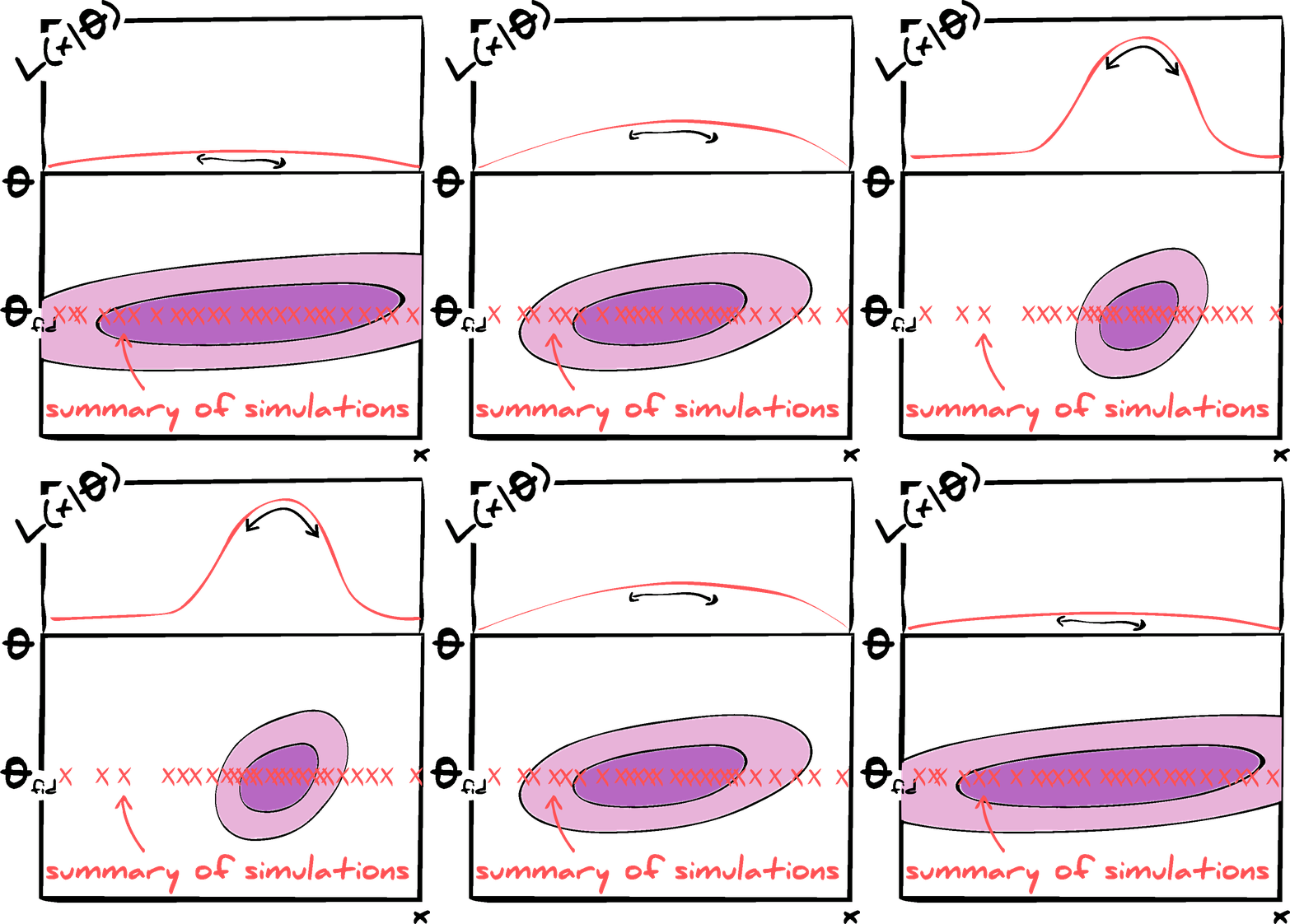
Fisher information of the network summaries
Simulations $\{{\bf d}_i|i\in[1, n_{\bf d}]\}$ at a single parameter value $\boldsymbol{\theta}^*$
Seed matched simulations $\{{\bf d}_i^{\pm}|i\in[1, n_{\bf p}]\}$ at perturbed fiducial paremeters $\Delta\boldsymbol{\theta}^\pm=\boldsymbol{\theta}\pm\boldsymbol{\delta}$
Calculate the covariance
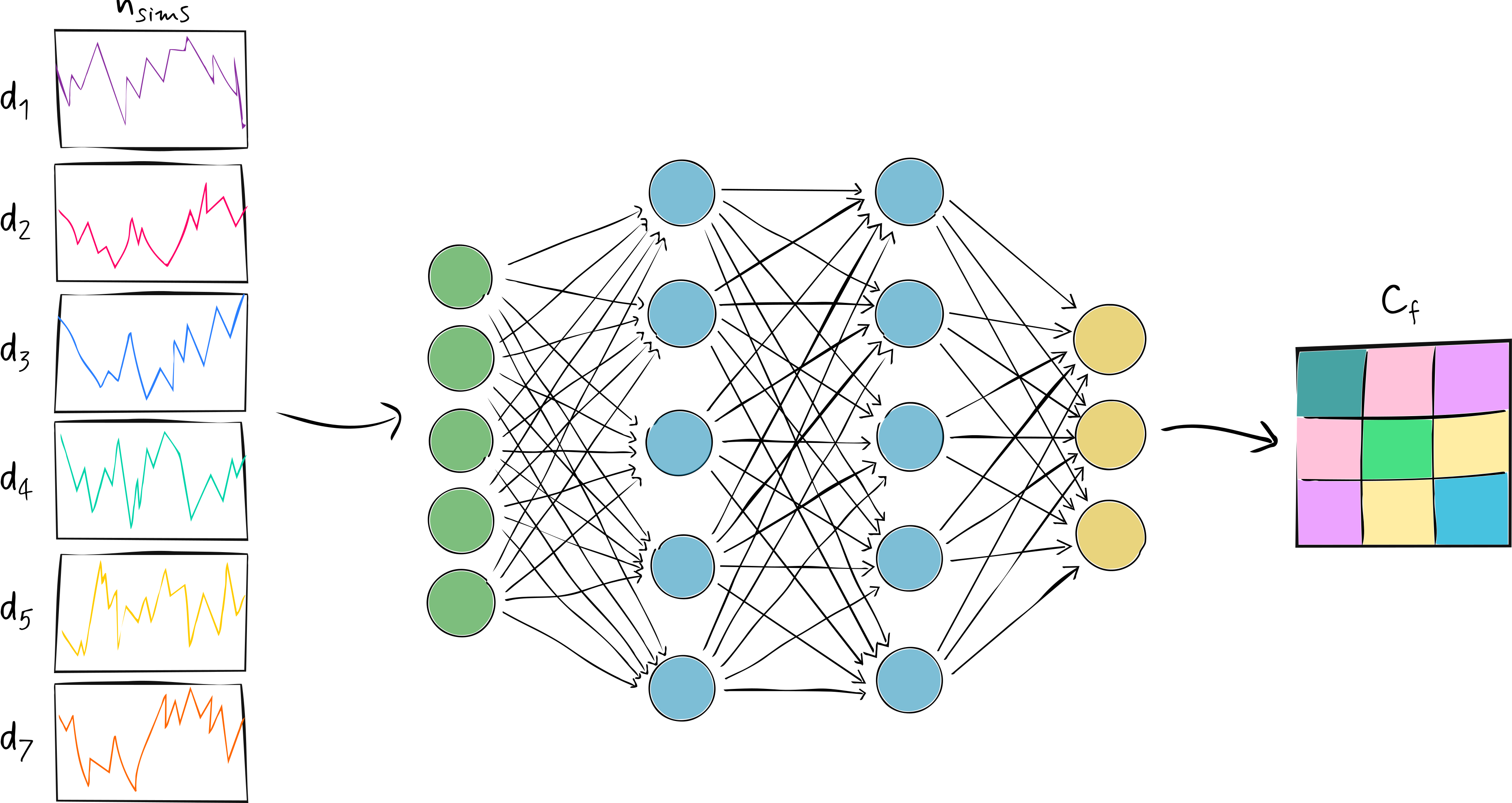
Calculate the derivative of the mean of the summaries with respect to the parameters
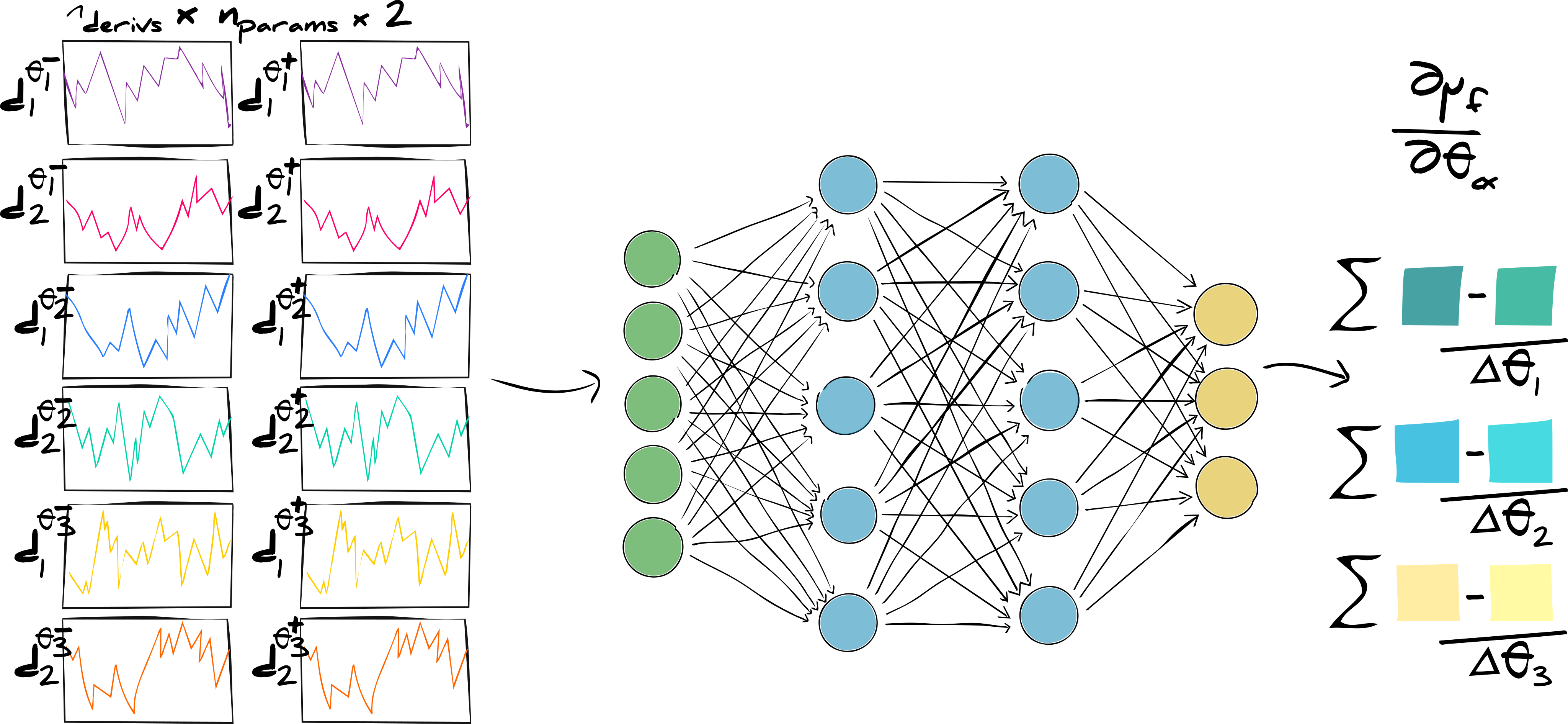
Calculate the Fisher information
$${\bf F}_{\alpha\beta}=\frac{\partial\mu_\mathscr{f}}{\partial\theta_\alpha}^T{\bf C}^{-1}_\mathscr{f}\frac{\partial\mu_\mathscr{f}}{\partial\theta_\beta}$$This Gaussian form forces the summaries to be Gaussianised
Optimise the tunable parameters of the network such that $\ln|{\bf F}_{\alpha\beta}|$ is maximised!
Once converged the network compresses and Gaussianises the data without losing information*
*in the optimal case...
And we get free maximum likelihood estimates...
$$\boldsymbol{\theta}^\textsf{MLE}_\alpha=\boldsymbol{\theta}_\alpha^*+{\bf F}_{\alpha\beta}^{-1}{\bf C}_\mathscr{f}^{-1}\frac{\partial\mu_\mathscr{f}}{\partial\theta_\beta}({\bf x}-\mu_\mathscr{f})$$And we can get free approximations of the posterior
$$\textsf{Cov}[\boldsymbol{\theta}_\alpha^\textsf{MLE},\boldsymbol{\theta}_\beta^\textsf{MLE}] \ge {\bf F}_{\alpha\beta}^{-1}$$Or do likelihood-free inference
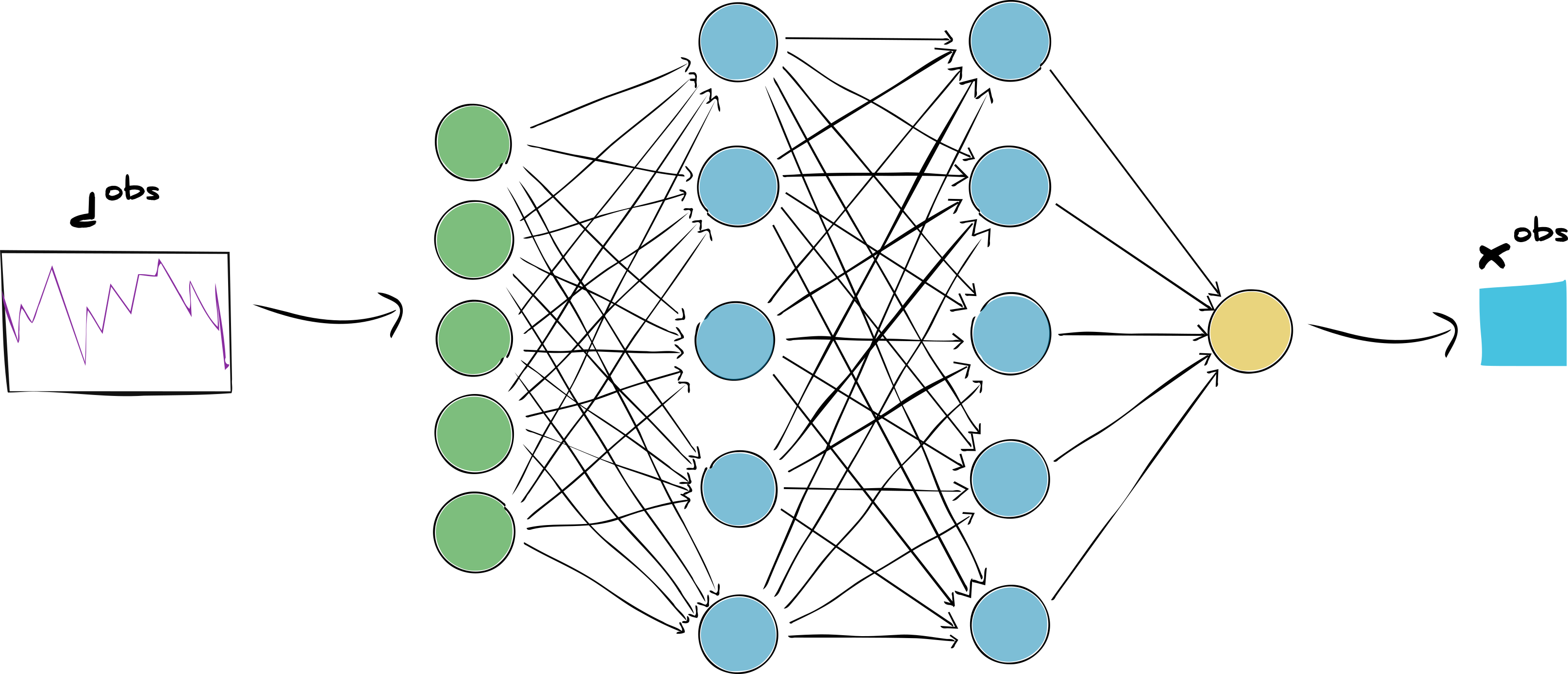
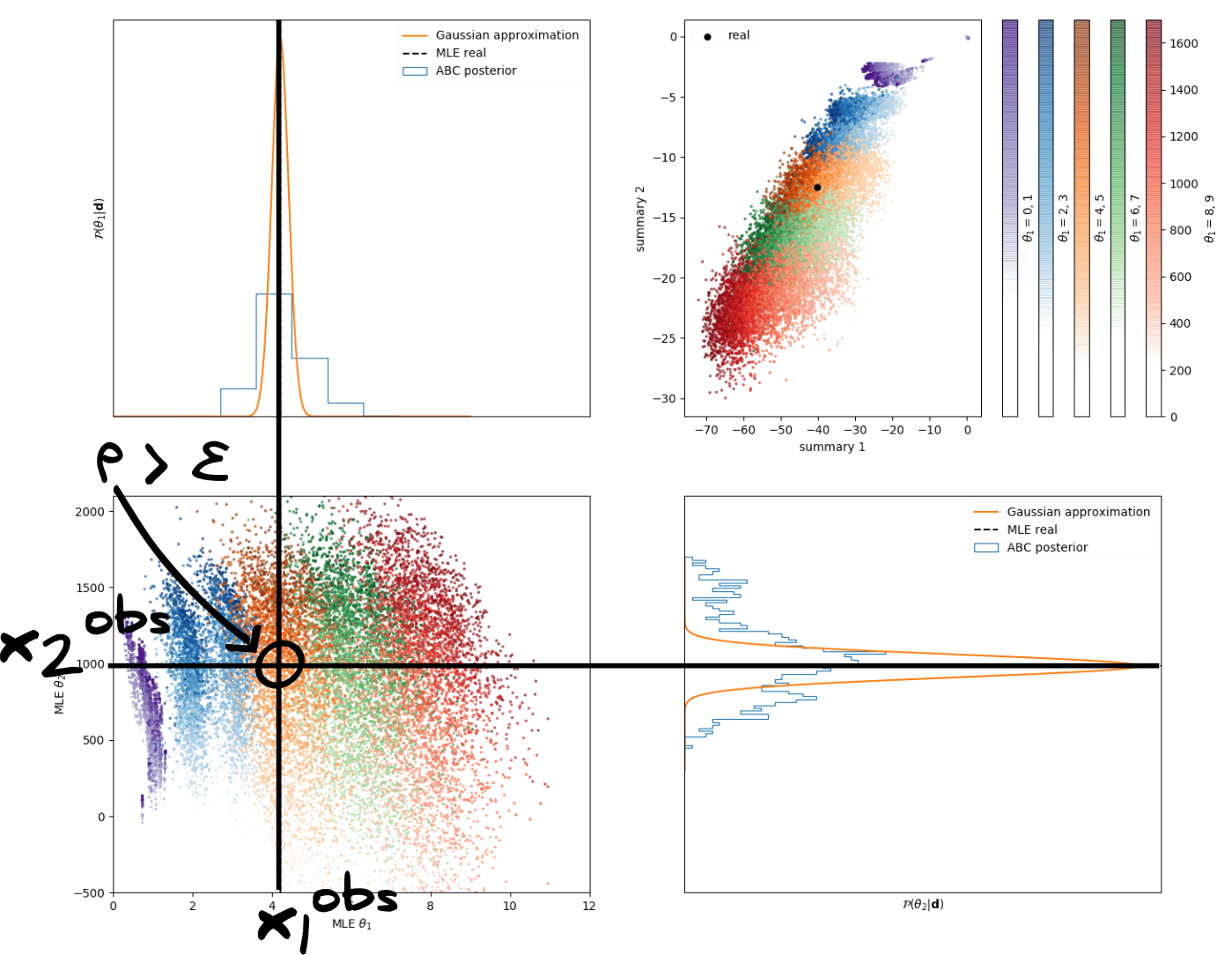
We pass our observed data through the network
(put it to the side)
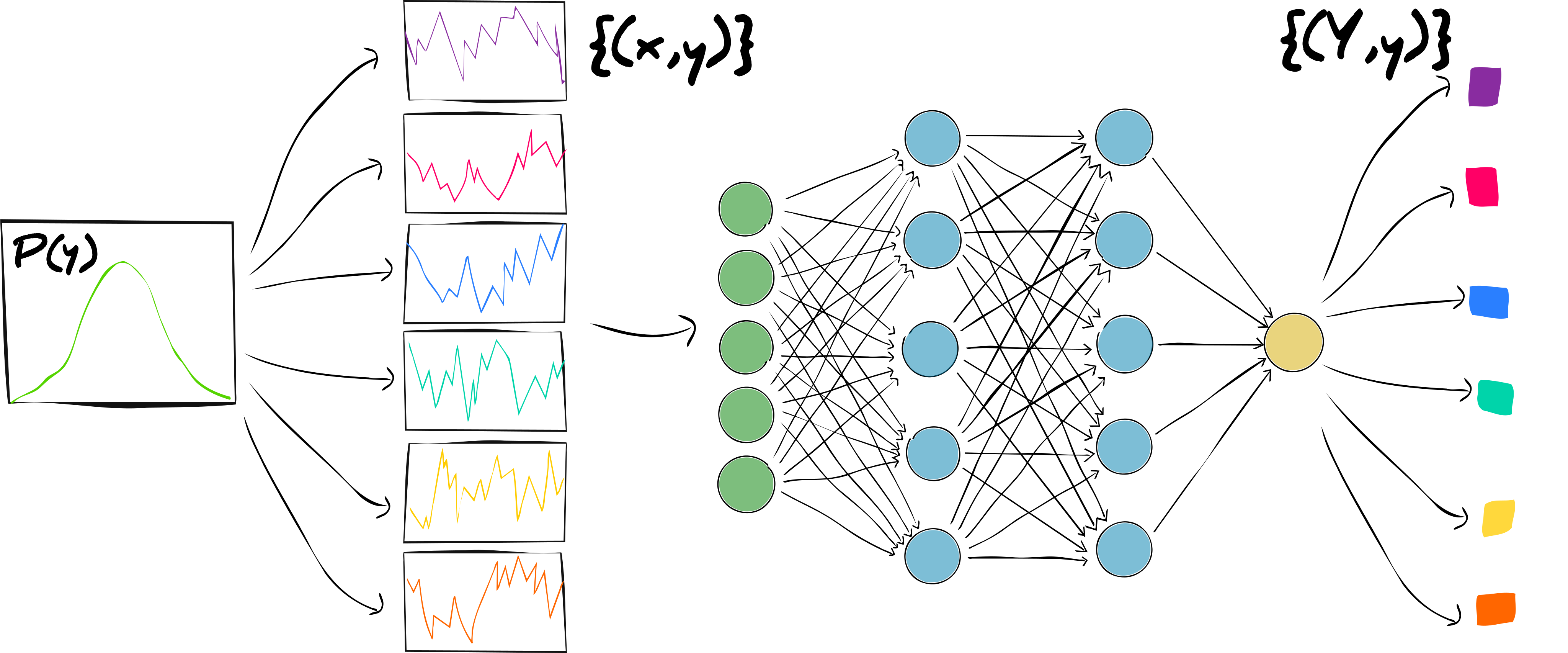
Draw simulations (cleverly?) from the prior model parameters, $\mathcal{P}(\boldsymbol{\theta})$ and pass them through the network
Measure the difference between the summarised simulations and the observed summary
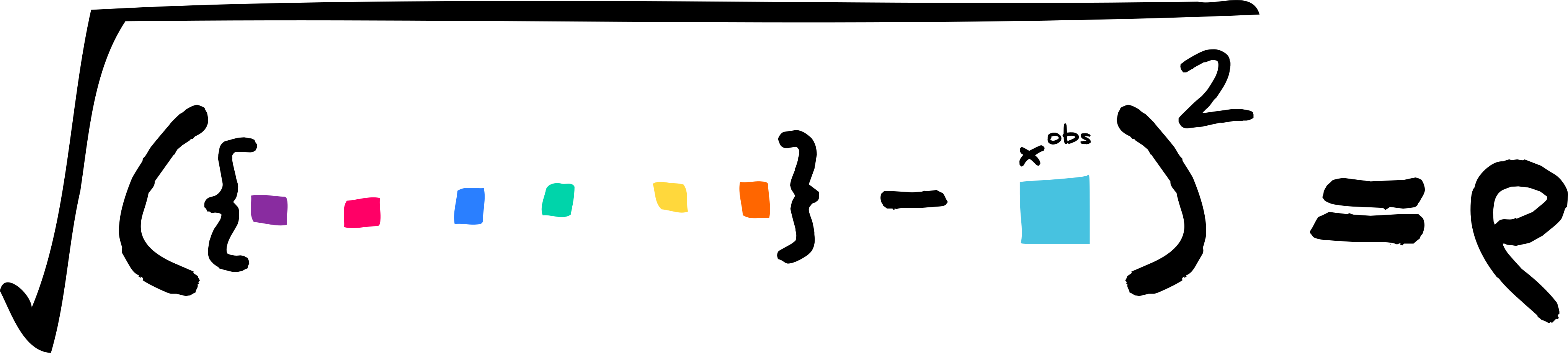
Compare distance between observed summaries and simulation summaries and select results within $\epsilon$
Conclusions
Great, but is there something better?
We could infer the neural network!
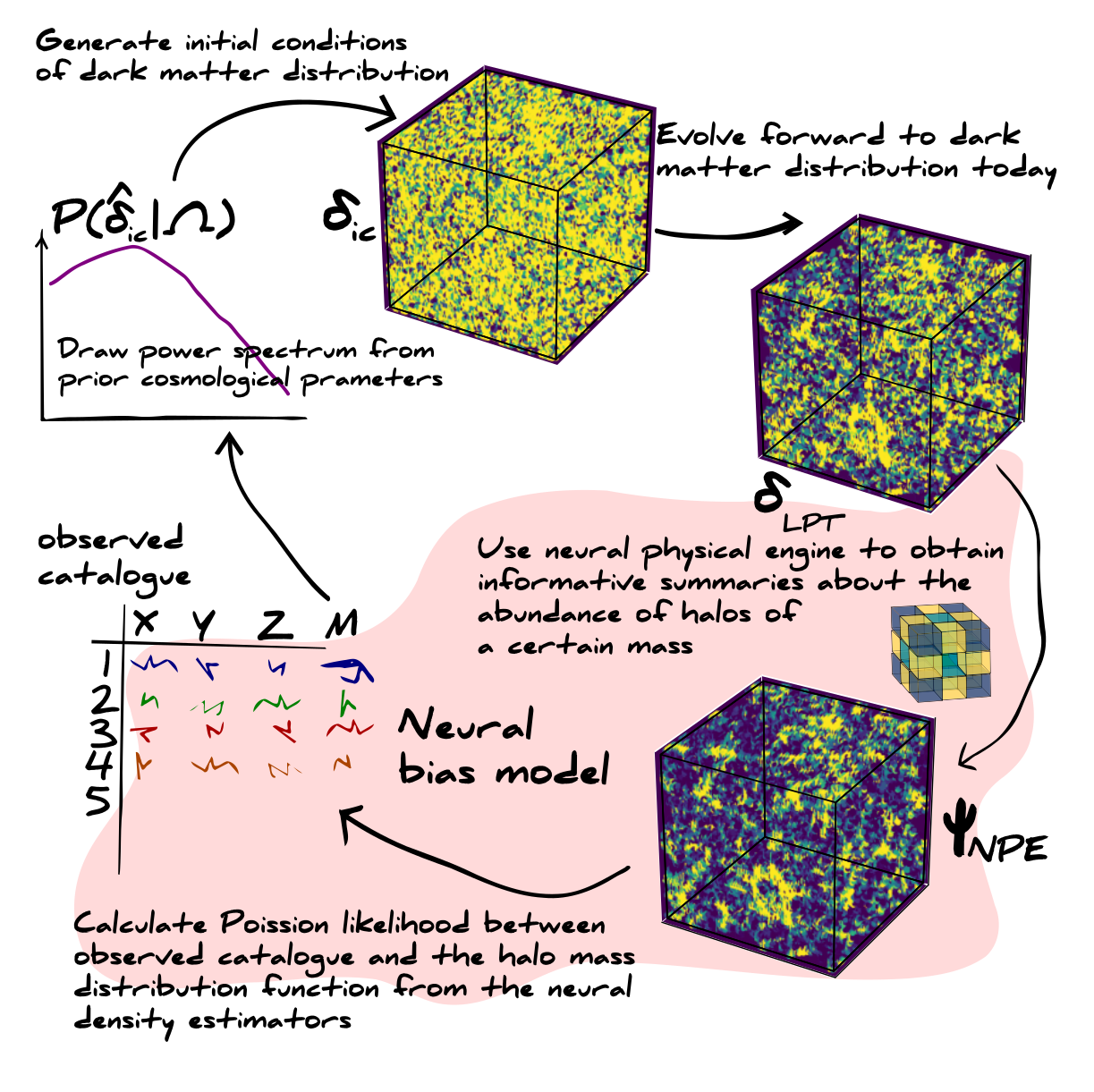
Neural physical engines
Build networks using physical principles.
Reduces number of parameters
Increases computational efficiency
Decreases overfitting
Improves interpretability
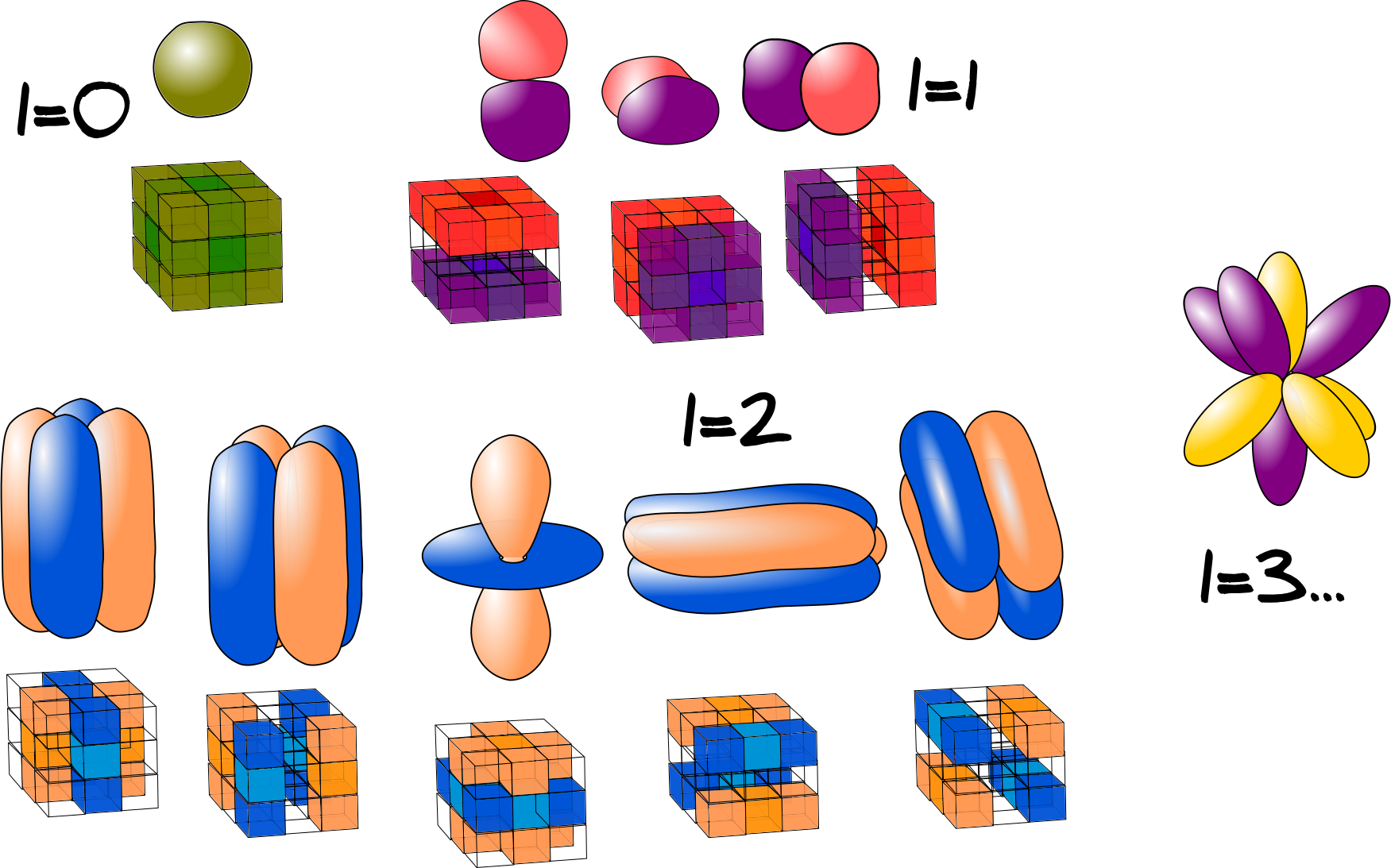
Convolutions for translational invariance
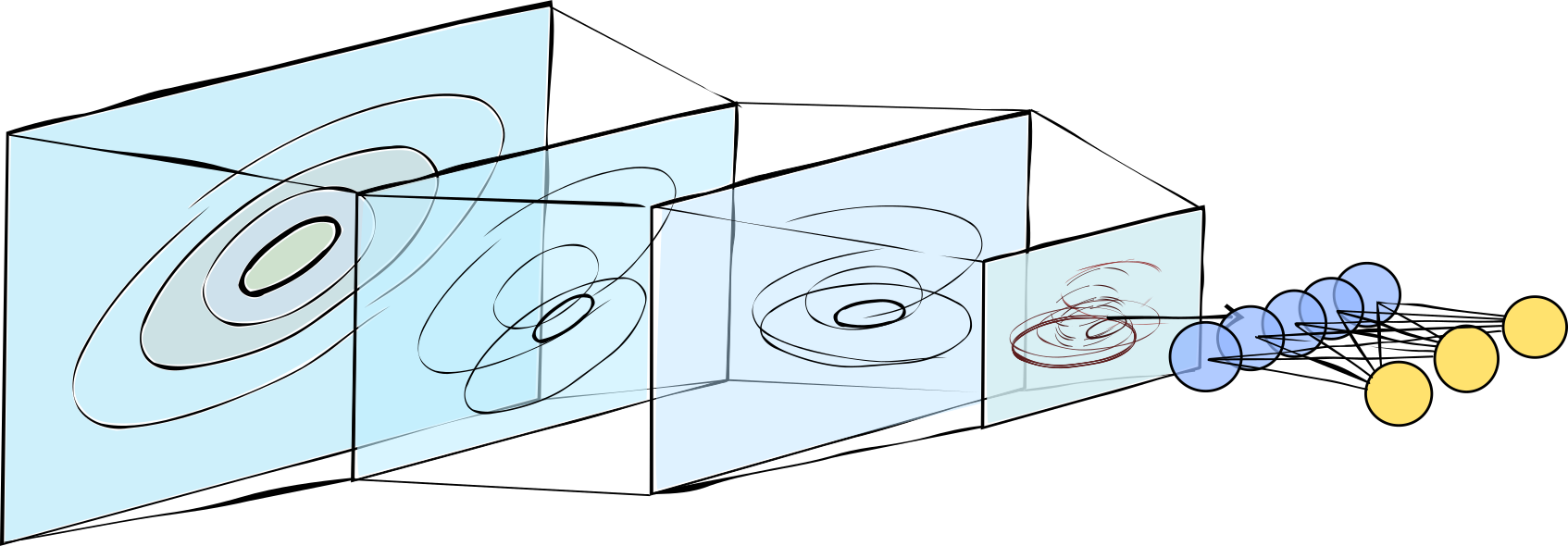
Use only causally relevant features
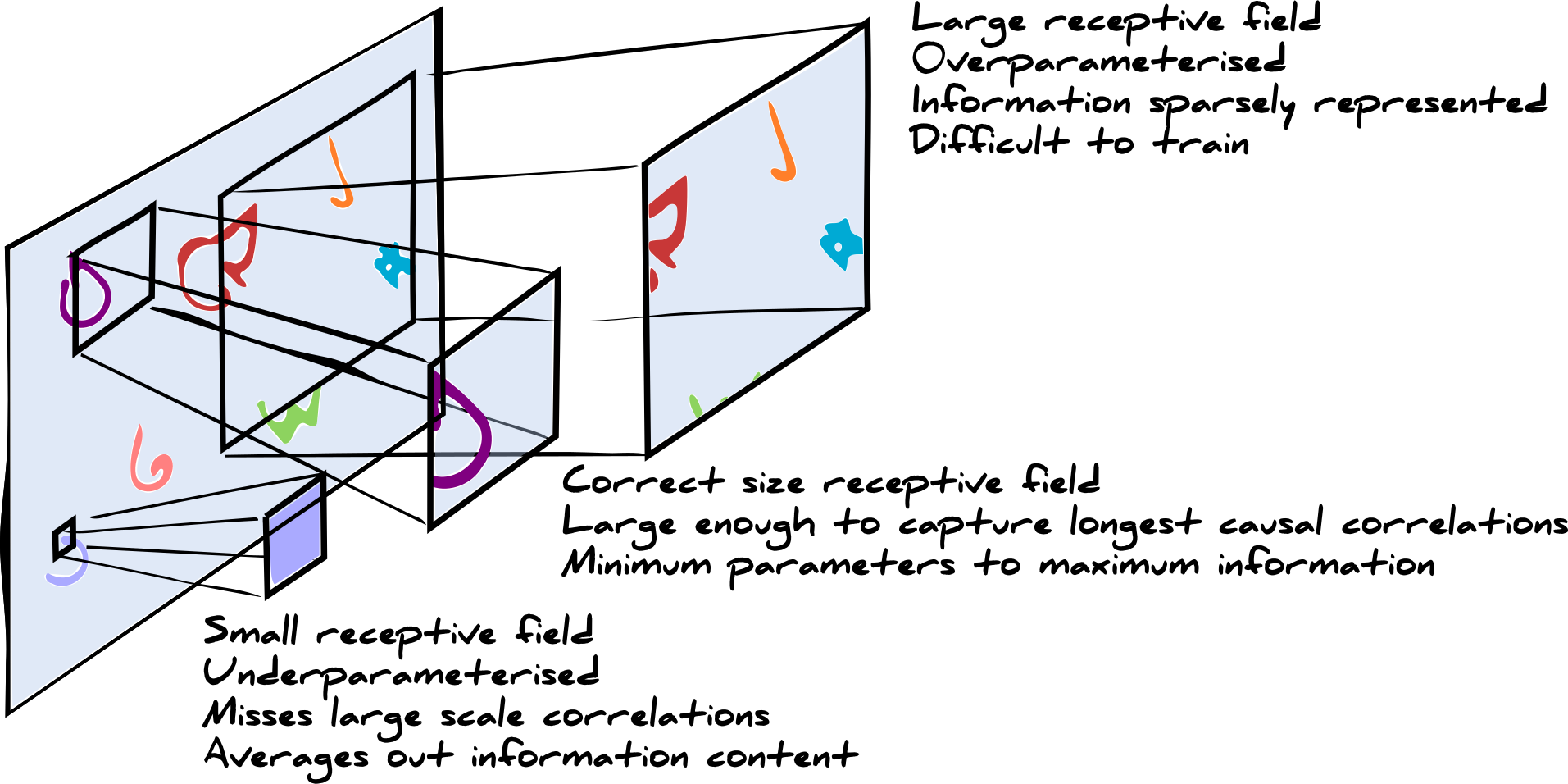
Use only informative features
Neural density estimators
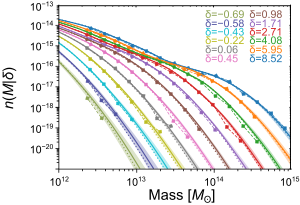
Halo mass distribution function is a smooth function of mass given a density environment
Use a mixture density network
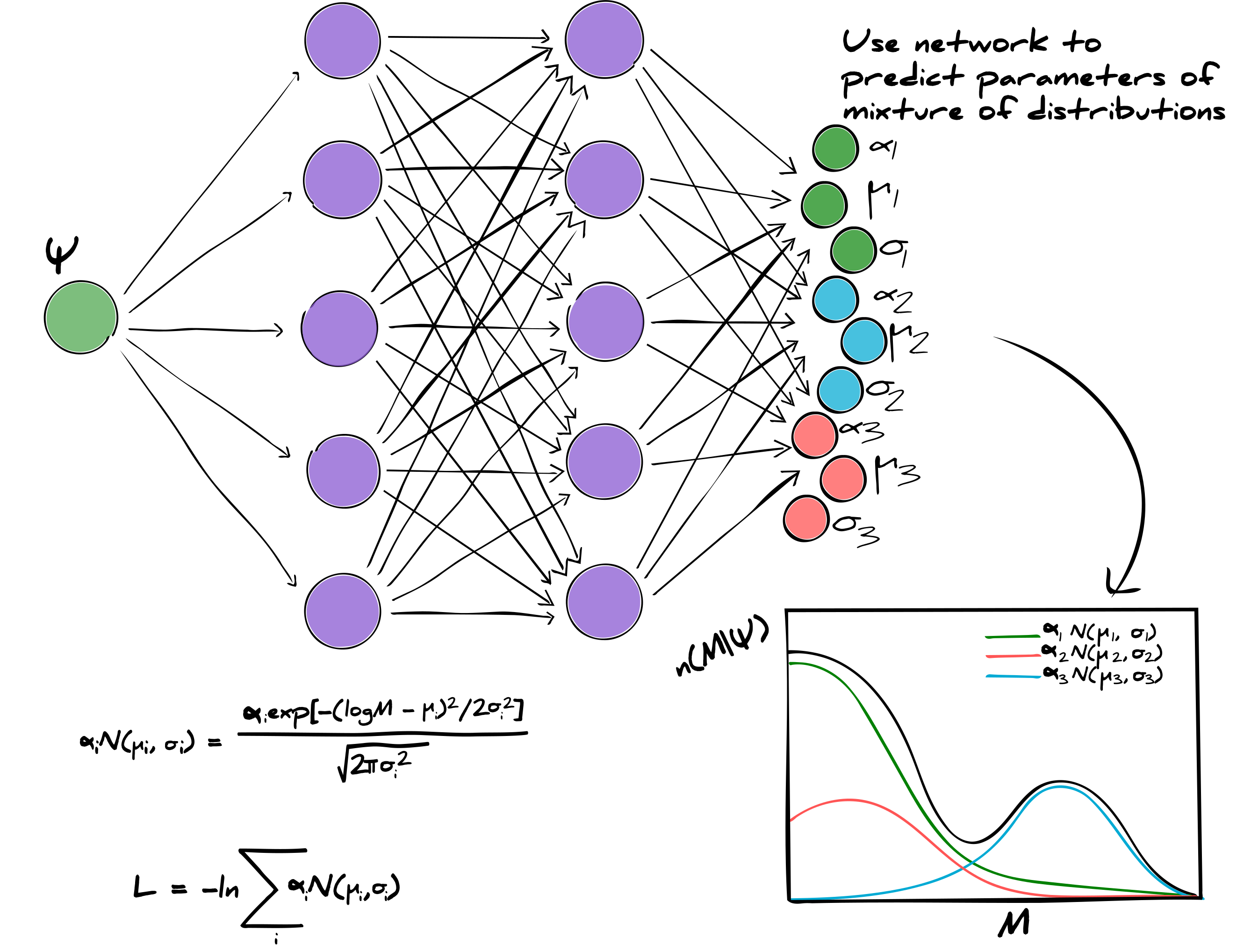
Our neural density estimator
$$\begin{align*} {\tiny n(M|\delta) =}&{\tiny \sum_i^N\alpha(\boldsymbol{\psi}, \boldsymbol{\theta}_i^{\boldsymbol{\alpha}})\mathcal{N}\left(\mu(\boldsymbol{\psi}, \boldsymbol{\theta}_i^{\boldsymbol{\mu}}), \sigma(\boldsymbol{\psi}, \boldsymbol{\theta}_i^{\boldsymbol{\sigma}})|M\right),}\\ {\tiny =}&{\tiny \sum_i^N\frac{\alpha(\boldsymbol{\psi}, \boldsymbol{\theta}_i^{\boldsymbol{\alpha}})}{\sqrt{2\pi\left(\sigma(\boldsymbol{\psi}, \boldsymbol{\theta}_i^{\boldsymbol{\sigma}})\right)^2}}\exp\left[-\frac{\left(\log(M) - \mu(\boldsymbol{\psi}, \boldsymbol{\theta}_i^{\boldsymbol{\mu}})\right)^2}{2\left(\sigma(\boldsymbol{\psi}, \boldsymbol{\theta}_i^{\boldsymbol{\sigma}})\right)^2}\right],}\end{align*} $$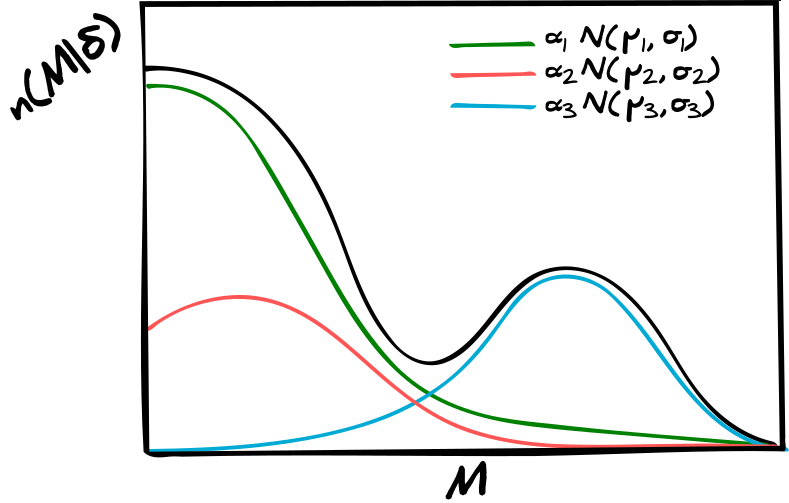
${\Tiny\boldsymbol{b}^\alpha \to \boldsymbol{b}^\alpha +\log(10^{-3})}$, ${\Tiny b_0^\mu \to b_0^\mu + \log\left(2\times10^{12}\right)}$ and ${\Tiny\boldsymbol{b}^\sigma\to \boldsymbol{b}^\alpha + \log(10^3)}$.
Likelihood
HMCLET
Hamiltonian Monte Carlo
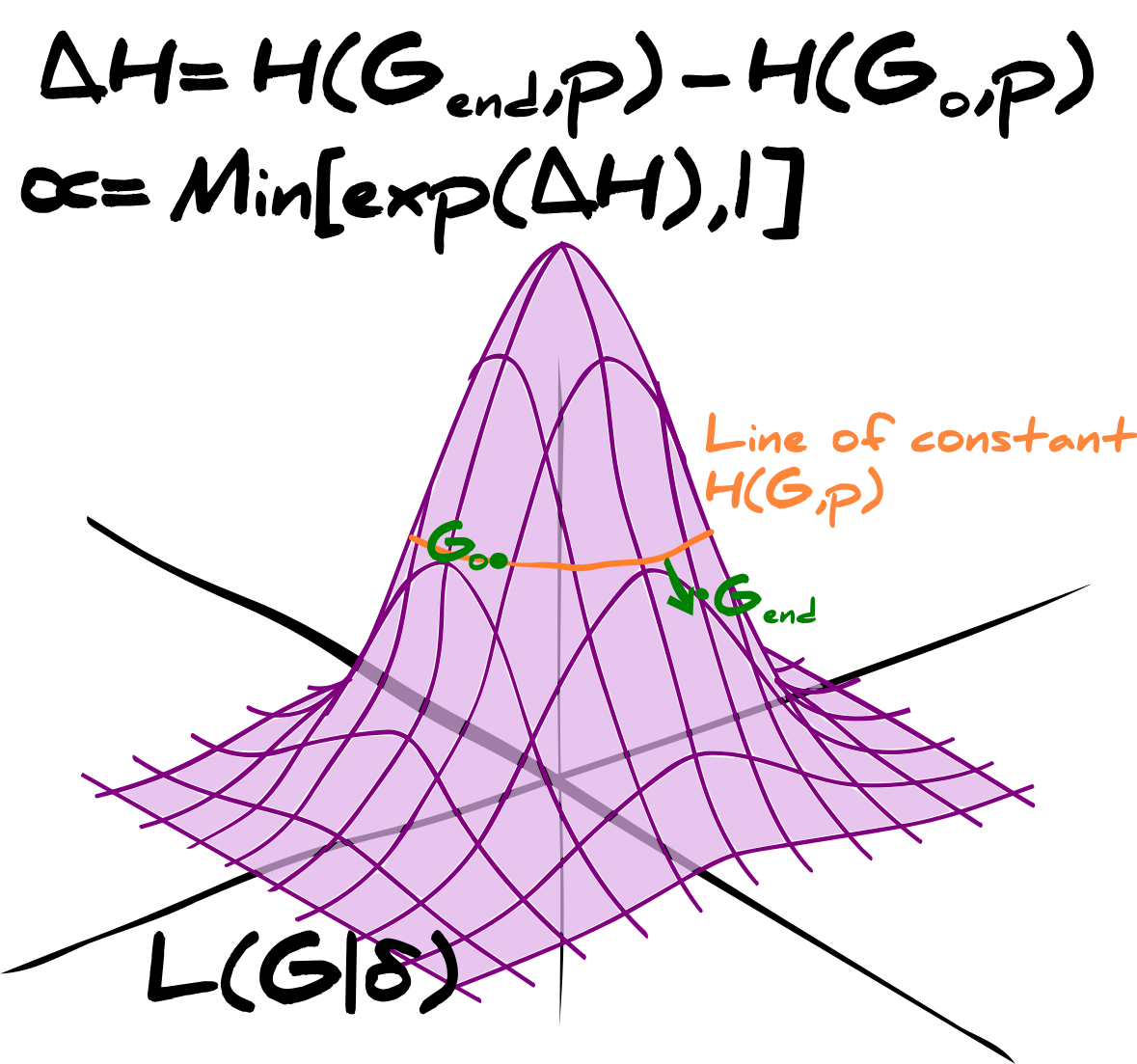
$$\begin{align*} {\Tiny\mathcal{H}(\boldsymbol{\theta}, {\bf p}) }&{\Tiny~= \mathcal{V}(\boldsymbol{\theta}) + \mathcal{K}({\bf p})}\\ &{\Tiny~=\mathcal{L}(\boldsymbol{\theta}|\boldsymbol{\delta})-\log\left[\pi(\boldsymbol{\theta})\right]+\frac{1}{2}{\bf p}^T{\bf M}^{-1}{\bf p}} \end{align*}$$ Accept samples according to probability $$\begin{equation*} {\Tiny\alpha = \textrm{Min}\left[\exp\left(\Delta\mathcal{H}\right), 1\right]} \end{equation*}$$
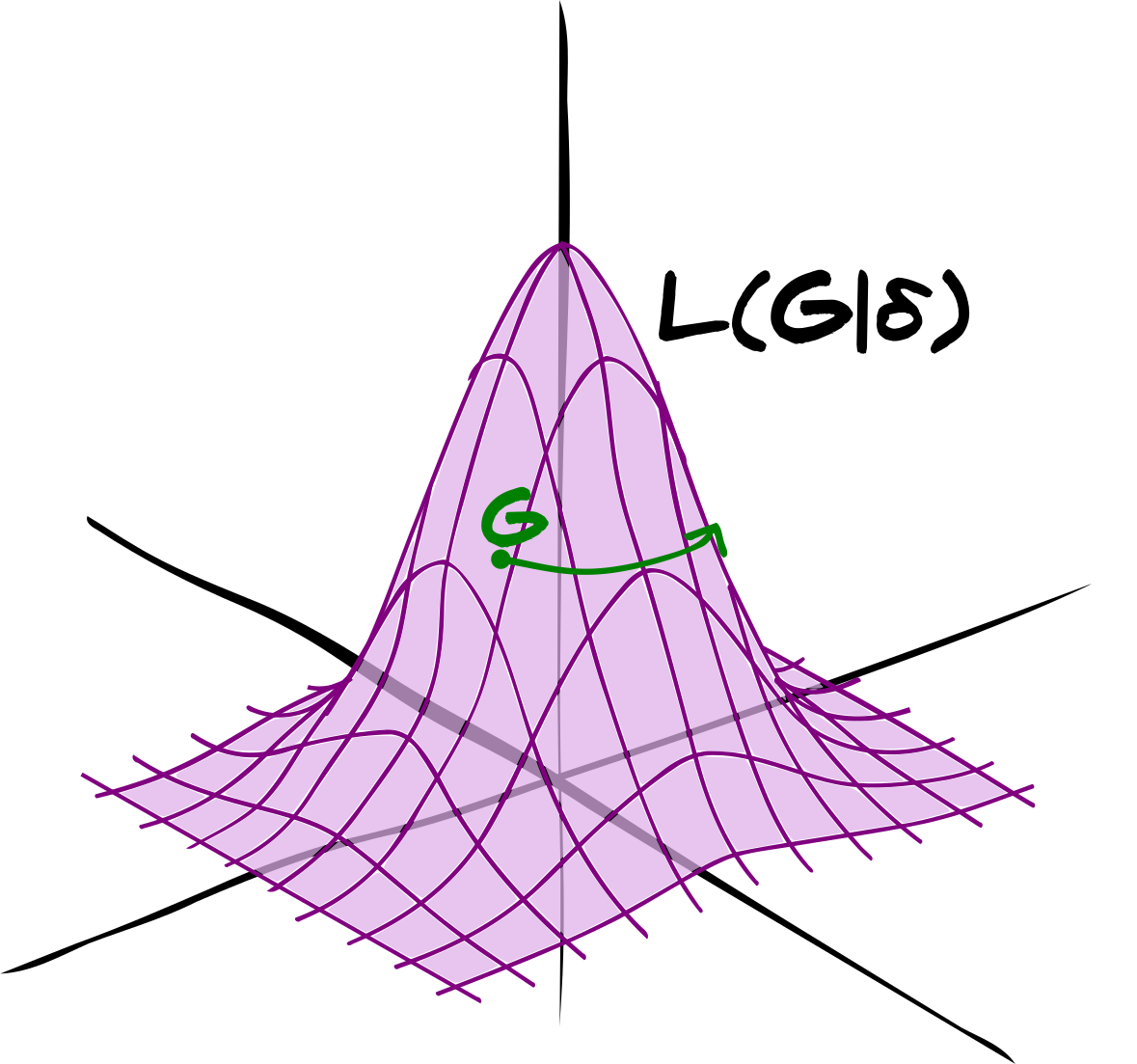
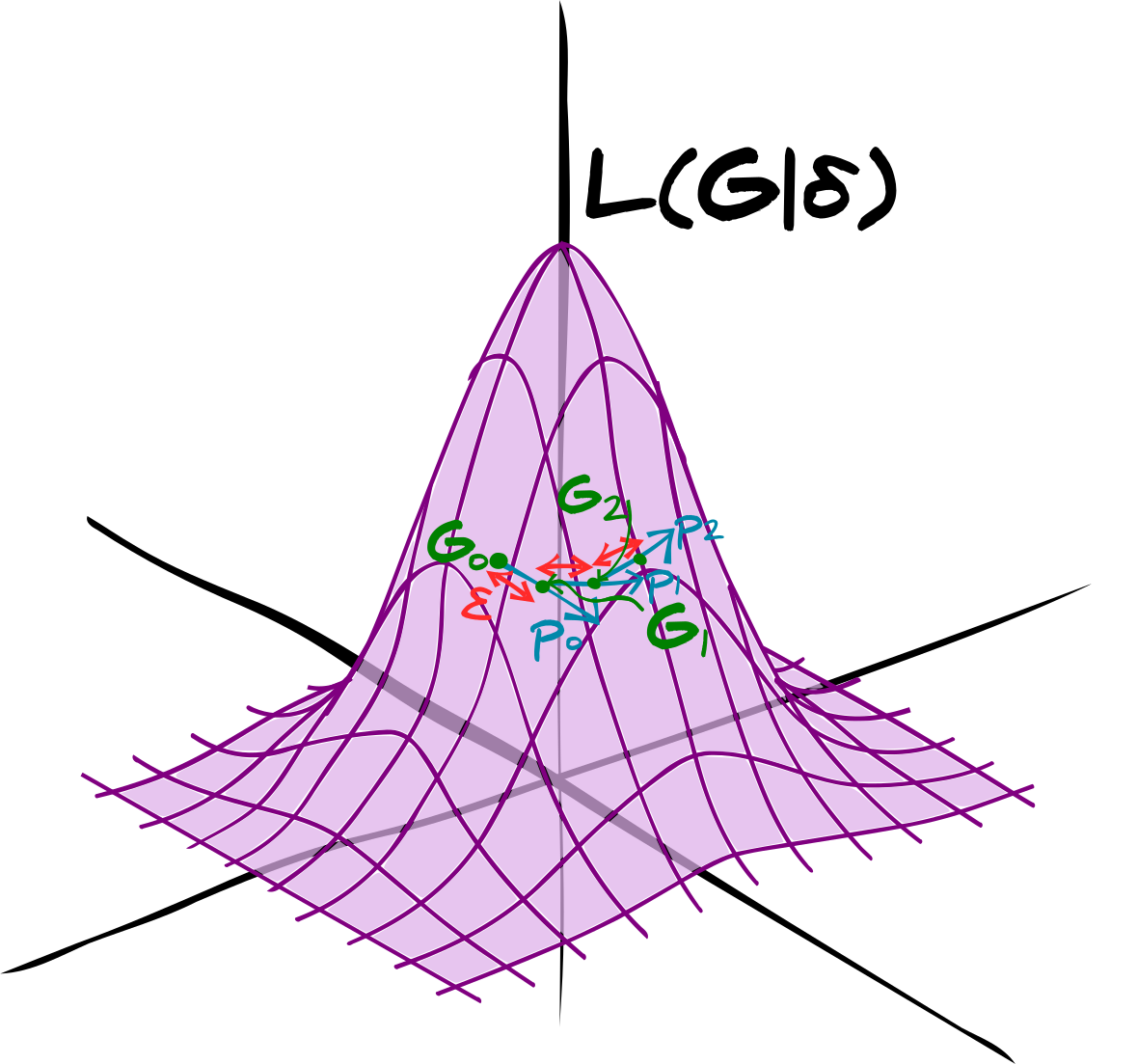
Leapfrog algorithm
Acceptance criterion
How does this work for neural networks?
Likelihood surface is extremely flat and highly degenerate
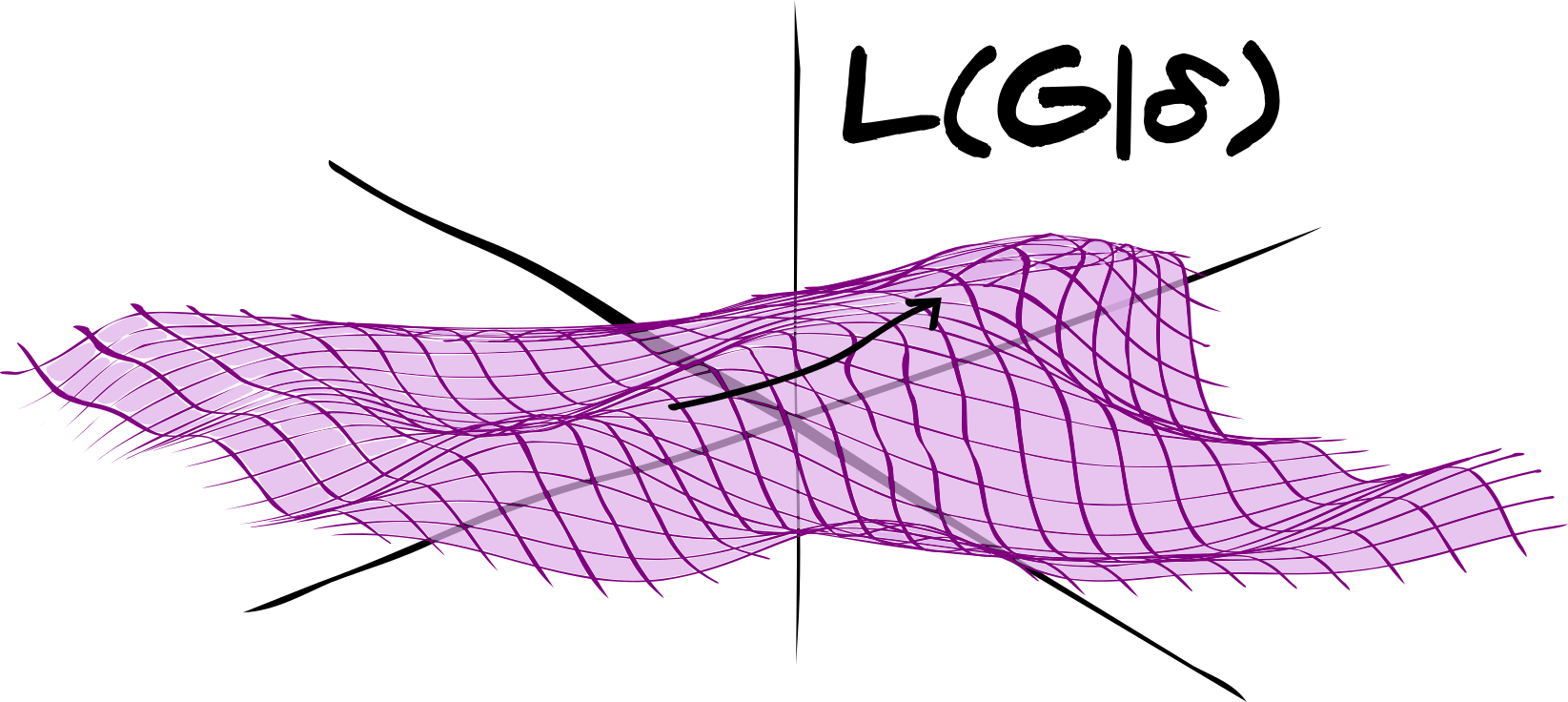
Nearly impossible to know the mass matrix, ${\bf M}$.
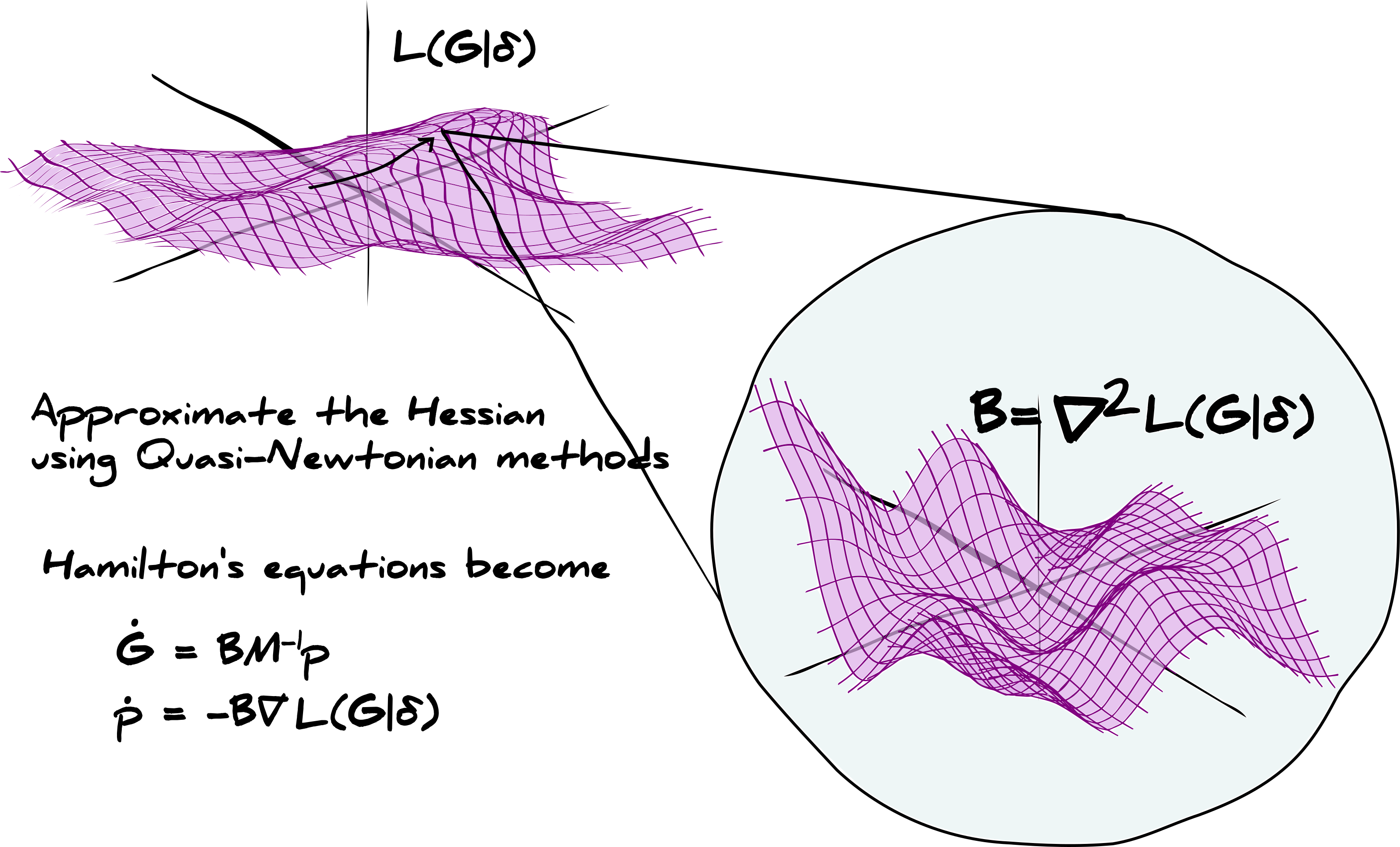
Use second order geometric information
Sample the power spectrum
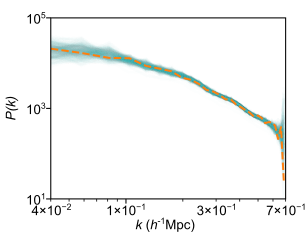 ✓ Power spectra remain smooth and close to prior
Sample the weights of the neural bias model
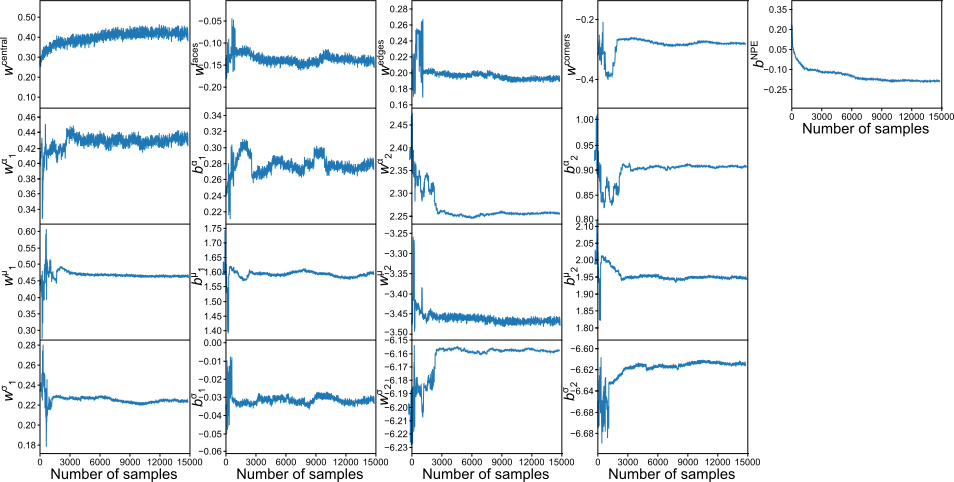
✓ Weight values are properly sampled after burn in
✓ NPE acts as a contrast enhancer
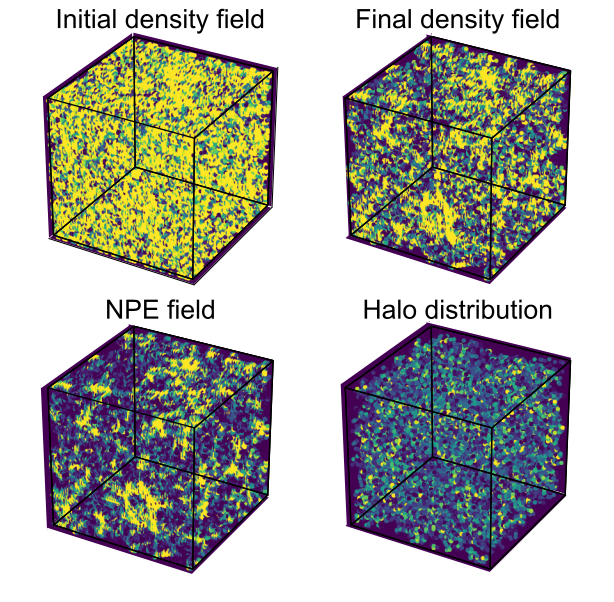
And what does the halo mass distribution function look like?
Halo mass distribution function from neural bias model
✓ Fits data!
Second conclusion
Take home message
Stop doing machine learning, think, then start doing machine learning again!